
Activated Carbon (Coconut-Shell, Coal-Based & Wood)
Granular, powdered and extruded activated carbon bought on iodine number, CTC, hardness and mesh
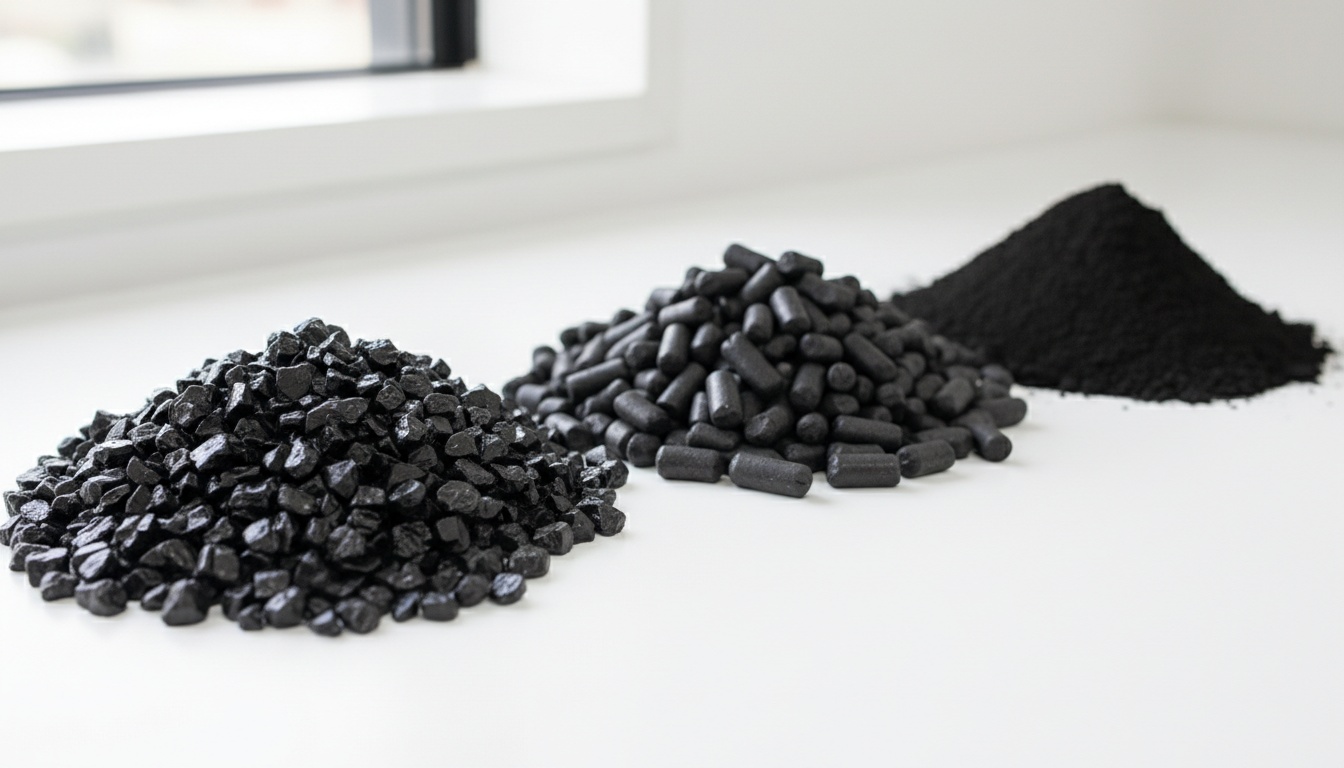
Activated carbon under HS 3802.10 is carbon that has been steam- or chemically activated into a network of micropores, and it is bought on adsorption numbers rather than on chemistry. The iodine number (ASTM D4607) states the milligrams of iodine one gram of carbon adsorbs and is the first figure on every specification; water-treatment grades sit in a band of roughly 600–1,100 mg/g. Carbon tetrachloride activity (ASTM D3467), or the butane activity that has replaced it in some laboratories, measures the pore volume that matters for vapour-phase work. Hardness and ash decide how a carbon survives handling: coconut-shell carbon is the hardest and lowest-ash of the common raw materials, which is why gold carbon-in-leach (CIL) and carbon-in-pulp (CIP) plants specify it and expect an iodine number of 1,000 mg/g and above with a CTC figure that confirms full activation. Granular carbon (GAC) is sold by US sieve range, with 8x30 and 12x40 the common water-treatment cuts and coarser cuts for gold plants; powdered carbon (PAC) is defined as 95–100% passing a stated sieve; extruded pellets run from 0.8 mm upward for gas-phase beds. Raw material sets the pore structure: coal-based carbon for municipal water and flue-gas mercury capture, wood-based and chemically activated carbon for sugar and glucose decolourising, coconut shell for gold, drinking water, air and gas.
UN Comtrade 2024 export declarations put HS 3802.10 at USD 2.32 billion across the reporters in the pull, led by China (19.3%, 316,863 MT), the United States (17.4%), India (13.2%, 177,940 MT), Belgium (8.4%), Sri Lanka (6.6%, 60,073 MT), the Philippines (5.2%, 206,697 MT), the Netherlands (4.9%), Germany (4.3%) and Japan (3.8%). Sri Lanka's industry is built on coconut shell: Haycarb, established in Colombo in 1973, states an annual production capacity above 58,500 MT across its plants. Buyers in the United States should note that certain activated carbon from China has been under a US antidumping duty order (case A-570-904) since 27 April 2007, continued after sunset review in November 2023 and still under administrative review in 2026, so a Chinese-origin cargo for a US discharge carries that duty exposure. CBIL is a commodity brokerage company and brokers activated carbon between activation plants and trader allocations on one side and water utilities, gold mines, sugar and glucose refineries, air-treatment and industrial buyers on the other, in 25 kg bags and 500 kg or 1,000 kg jumbo bags in containers, on FOB, CFR and CIF terms. Offers stand against a manufacturer or SGS, Bureau Veritas or Intertek test report giving iodine number, CTC or butane activity, hardness, ash, moisture, apparent density and sieve analysis, with a certificate of origin and a safety data sheet. Price is negotiated per lot on raw material, form and mesh. Send the application, the mesh and iodine number required and the discharge port, and the enquiry is screened and worked against it.
Need the ship as well? Our chartering desk prices Norway to India olivine sand freight on LaycanDesk.
Excluded origins are not offered, including product re-exported, blended or re-processed through a third country. Every lot moves with a certificate of origin naming the producing plant, mine or grower country, and nothing is quoted before the seller and loading point are known.
Indicative reference
Per MT, on raw material and grade USD / MT
as at September 2026
Reference level only — not an offer, and reviewed quarterly. Levels shown are as at September 2026. Firm pricing is quoted per RFQ, subject to volume, terms and inspection.
Typical Specification
Specifications are indicative and adjusted to the agreed contract and destination requirements. Final spec confirmed on COA / SGS.
Available Grades
Applications
- Municipal and industrial water treatment
- Gold carbon-in-leach and carbon-in-pulp recovery
- Sugar, glucose and edible-oil decolourising
- Air purification, solvent recovery and gas masks
- Flue-gas mercury and dioxin capture
- Food, beverage and pharmaceutical purification
Category
Industrial Minerals & Construction
Incoterms
FOB · CFR · CIF
Pricing basis
USD / MT
Inspection
SGS / Intertek at load port
Activated Carbon (Coconut-Shell, Coal-Based & Wood) — buyer questions
What does the iodine number tell a buyer?
The milligrams of iodine one gram of carbon adsorbs under ASTM D4607, which tracks micropore content and the degree of activation. Water-treatment carbons sit broadly between 600 and 1,100 mg/g; gold CIL and CIP plants expect 1,000 mg/g and above from a coconut-shell carbon, together with a carbon tetrachloride activity that confirms the activation went to completion.
Why is coconut-shell carbon specified for gold plants?
Hardness and ash. Coconut-shell carbon is the hardest and lowest-ash of the common raw materials, so it survives the attrition of agitated leach tanks and elution circuits with less fines loss, and its microporous structure suits gold cyanide adsorption. Coal-based and wood-based carbons have their own place in water, flue-gas and decolourising duties.
Which countries export the most activated carbon?
UN Comtrade 2024 export declarations for HS 3802.10 total USD 2.32 billion in the reporters pulled: China 19.3%, the United States 17.4%, India 13.2%, Belgium 8.4%, Sri Lanka 6.6%, the Philippines 5.2%, the Netherlands 4.9%, Germany 4.3% and Japan 3.8%. By tonnage the Philippines (206,697 MT) and China (316,863 MT) lead, reflecting lower unit values than the European re-exporters.
Is there a duty issue on Chinese activated carbon?
For the United States, yes. Certain activated carbon from China has been under a US antidumping duty order, case A-570-904, since 27 April 2007; the order was continued after sunset review in November 2023 and remains under annual administrative review. A Chinese cargo for a US buyer carries that exposure; other destinations are checked case by case.
What documents come with a lot?
A manufacturer or third-party test report (SGS, Bureau Veritas or Intertek) covering iodine number, CTC or butane activity, hardness, ash, moisture, apparent density and sieve analysis, a certificate of origin, a safety data sheet and the bill of lading. Food-contact and drinking-water grades carry the certification the destination requires.
Ready to source Activated Carbon?
Send your quantity, specification, preferred Incoterms and destination port. Qualified requirements receive a workable offer against verified supply.
Have Activated Carbon to sell? Submit an offer — we'll match it against live buyer demand.
More in Industrial Minerals
Bentonite (API 13A Drilling, Foundry & Civil Piling Grades)
High-yield sodium and activated bentonite — API 13A oilfield, green sand foundry & diaphragm piling
Titanium Minerals (Ilmenite, Rutile & Titanium Slag)
Sulphate and chloride ilmenite, natural and synthetic rutile, leucoxene and slag by TiO₂ content
Zircon Sand & Zircon Flour
Premium, standard and ceramic-grade zircon sand and milled flour by ZrO₂+HfO₂, iron and titanium
Drilling-Grade Barite (API 13A)
API 13A barite at 4.10 and 4.20 specific gravity, lumps and ground powder
Silica Sand & Quartz (Glass, Foundry, Frac, High-Purity)
Glass, foundry and frac sand and quartz, bought on SiO₂, iron and grain size
Kaolin & Ball Clay
Paper coating and filler kaolin, calcined kaolin and ceramic ball clay by brightness and particle size
Feldspar & Nepheline Syenite
Sodium and potassium feldspar and nepheline syenite by alkali, alumina and iron
Olivine Sand & Lump Flux
Natural magnesium iron silicate rock and sand for blast furnace slag conditioning, foundry sand and refractories
High-Purity Quartz (HPQ 4N8 / 5N & Crucible Sand)
HPQ 4N to 5N granular sand and lump for solar CZ crucibles and semiconductor wafer pulling
Talc (Paint, Ceramic, Paper, Polymer & Cosmetic Grades)
Lump and micronised talc by brightness, particle size and asbestos-free certification
Perlite & Vermiculite (Crude Ore and Expanded)
Crude perlite ore, crude vermiculite concentrate and expanded grades for horticulture, construction and filter aids
Silicon Carbide (Black & Green, Metallurgical, Abrasive & Refractory)
Black and green SiC as metallurgical lumps, FEPA-graded abrasive grain and refractory aggregate
Borates (Colemanite, Ulexite, Boric Acid & Borax Pentahydrate)
Ground and granular colemanite, ulexite, boric acid and borax pentahydrate sold on B₂O₃ content
Garnet Sand (Blasting & Waterjet Grades)
Almandine garnet for abrasive blasting and waterjet cutting, sold by mesh cut and origin
Wollastonite, Kyanite & Mica (Ceramic, Refractory & Filler Minerals)
Acicular wollastonite, kyanite-group refractory minerals and muscovite and phlogopite mica for ceramics, refractories and fillers