
Wollastonite, Kyanite & Mica (Ceramic, Refractory & Filler Minerals)
Acicular wollastonite, kyanite-group refractory minerals and muscovite and phlogopite mica for ceramics, refractories and fillers
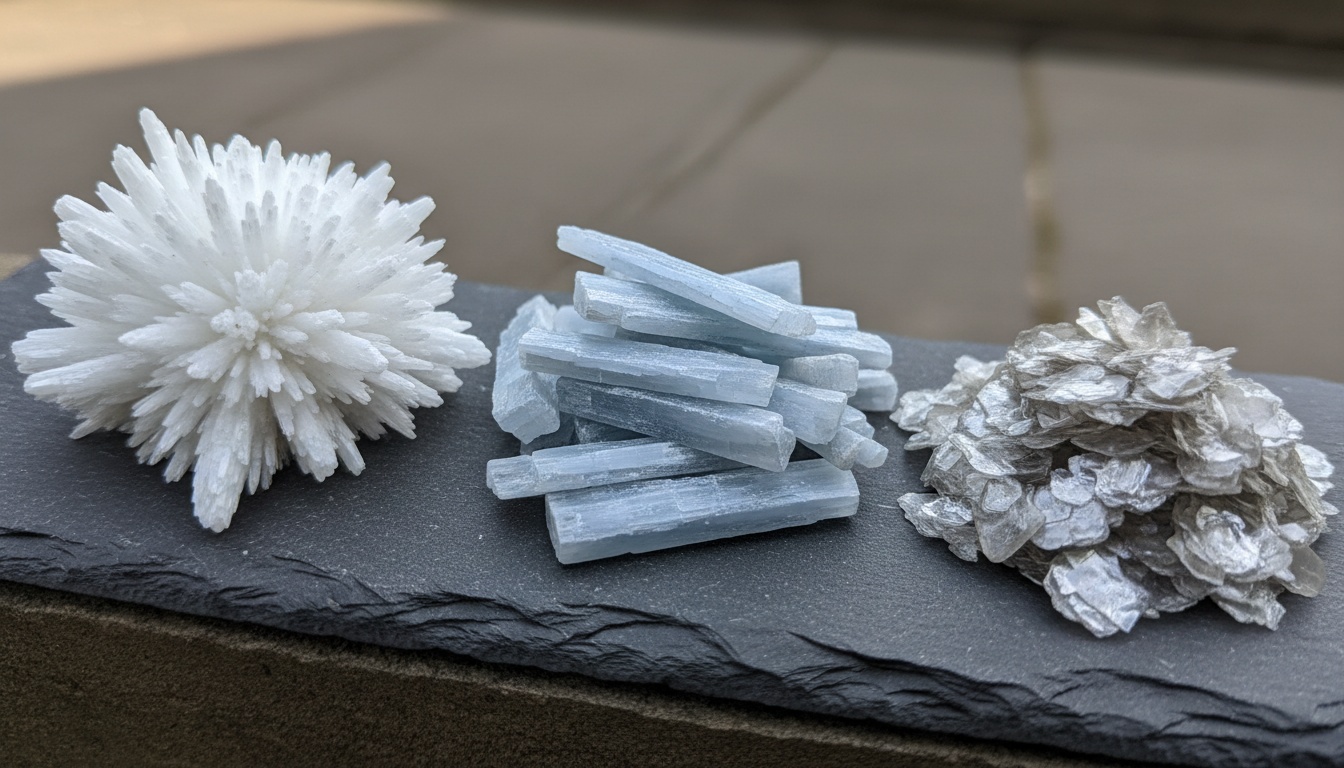
Wollastonite (HS 2530.90) is a calcium metasilicate that grows as needles, and the needle is the product. Grades are sold on aspect ratio, from about 5:1 in milled powder grades to 15:1 and above in high-aspect grades, and on fineness, with median particle sizes from about 13 microns in polymer-reinforcing grades to 325-mesh powders for coatings, ceramics and adhesives. Its Mohs hardness of 4.5–5, specific gravity of 2.86–3.09, white colour and 1,540°C melting point make it a ceramic-body flux that cuts shrinkage and crazing, a reinforcing filler in thermoplastics and elastomers, a pH buffer and weathering aid in paint, and an asbestos substitute in friction and construction products. Estimated world crude ore production was around 1.2 million MT (USGS 2021 summary), with China the largest producer and India, the United States, Mexico and Finland the other sources; ceramics take roughly 30–40% of sales and polymers 30–35%.
Kyanite, andalusite and sillimanite (HS 2508.50) share the formula Al₂SiO₅ and are bought as refractory raw materials on Al₂O₃ content, iron and sizing. Heated above about 1,100°C kyanite converts to mullite and silica with a volume expansion, which refractory makers use to offset firing shrinkage in bricks, castables, kiln furniture, investment-casting shells and porcelain bodies; calcined kyanite is sold already mullitised, and andalusite converts with little expansion so it goes into monolithics and high-duty bricks directly. Sources are the United States, South Africa, India, France and Peru, and Chinese sillimanite-group minerals. Mica (HS 2525) means muscovite in the electrical and cosmetic trade and phlogopite where service temperatures to 900°C are needed. It moves as sheet and block, as scrap and flake recovered as a by-product of feldspar and kaolin processing, and as dry-ground or wet-ground powder; US consumption has been led by drywall joint compound (54% in 2008), paint (22%) and drilling fluids (15%), and wet-ground mica supplies pearlescent pigments and cosmetics. Mica from Jharkhand and Bihar in India, and from Madagascar, is partly mined artisanally with documented child labour; the Responsible Mica Initiative has tracked supply-chain remediation there since 2017, and any Indian or Malagasy mica CBIL works carries a traceable licensed-mine or processor chain and the buyer's due-diligence questionnaire. CBIL is a commodity brokerage company and brokers these minerals between miners, millers and trader allocations on one side and ceramic, refractory, polymer, paint, drilling-fluid and cosmetic-pigment plants on the other, in 25 kg bags and 1–1.5 MT jumbo bags in containers or bulk vessel lots for refractory aggregate, on FOB, CFR and CIF terms. Offers stand against an SGS, Bureau Veritas or Intertek analysis of chemistry, loss on ignition, brightness where relevant, sieve or particle-size distribution and, for wollastonite, aspect ratio, with a certificate of origin and a safety data sheet. Price is negotiated per lot on grade. Send the mineral, the grade and the discharge port, and the enquiry is screened and worked against it.
Need the ship as well? Our chartering desk prices Norway to India olivine sand freight on LaycanDesk.
Excluded origins are not offered, including product re-exported, blended or re-processed through a third country. Every lot moves with a certificate of origin naming the producing plant, mine or grower country, and nothing is quoted before the seller and loading point are known.
Indicative reference
Per MT, on mineral and grade USD / MT
as at September 2026
Reference level only — not an offer, and reviewed quarterly. Levels shown are as at September 2026. Firm pricing is quoted per RFQ, subject to volume, terms and inspection.
Typical Specification
Specifications are indicative and adjusted to the agreed contract and destination requirements. Final spec confirmed on COA / SGS.
Available Grades
Applications
- Ceramic tile, sanitaryware and porcelain bodies (wollastonite, kyanite)
- Refractory bricks, castables, kiln furniture and investment-casting shells
- Thermoplastic and elastomer reinforcement
- Paint, coatings and joint compounds
- Drilling fluids and lost-circulation material (mica)
- Pearlescent pigments, cosmetics and electrical insulation (mica)
Category
Industrial Minerals & Construction
Incoterms
FOB · CFR · CIF
Pricing basis
USD / MT
Inspection
SGS / Intertek at load port
Wollastonite, Kyanite & Mica (Ceramic, Refractory & Filler Minerals) — buyer questions
What is aspect ratio in wollastonite and why does it matter?
The length-to-width ratio of the needle-shaped crystal. Milled powder grades sit around 5:1 and high-aspect grades at 15:1 and above. Long needles form a touching network inside a polymer or ceramic matrix that stiffens it and controls shrinkage; the higher the ratio, the more reinforcement per kilo, and the more carefully the grade has to be milled and handled to keep it.
What is calcined kyanite?
Kyanite fired above about 1,100°C so that it has already converted to mullite and silica. Raw kyanite expands as it converts, which refractory makers use to counter firing shrinkage; calcined kyanite is dimensionally stable and used where that expansion is not wanted. Andalusite converts with little expansion and goes directly into monolithics and high-duty bricks.
What forms of mica are traded?
Sheet and block mica for electrical and specialty uses, scrap and flake mica recovered largely as a by-product of feldspar and kaolin processing, and ground mica in dry-ground grades for joint compounds, paint and drilling fluids and wet-ground grades for pearlescent pigments and cosmetics. Muscovite is the electrical and cosmetic mica; phlogopite serves to 900°C.
How does CBIL handle the child-labour issue in mica?
Mica in Jharkhand and Bihar and in Madagascar is partly mined artisanally with documented child labour, and the Responsible Mica Initiative has tracked remediation there since 2017. Indian or Malagasy mica is worked only with a traceable licensed-mine or processor chain and the buyer's supply-chain due-diligence questionnaire completed; flake and ground mica from the United States, Finland and other by-product sources is available where that is preferred.
Ready to source Wollastonite, Kyanite & Mica?
Send your quantity, specification, preferred Incoterms and destination port. Qualified requirements receive a workable offer against verified supply.
Have Wollastonite, Kyanite & Mica to sell? Submit an offer — we'll match it against live buyer demand.
More in Industrial Minerals
Bentonite (API 13A Drilling, Foundry & Civil Piling Grades)
High-yield sodium and activated bentonite — API 13A oilfield, green sand foundry & diaphragm piling
Titanium Minerals (Ilmenite, Rutile & Titanium Slag)
Sulphate and chloride ilmenite, natural and synthetic rutile, leucoxene and slag by TiO₂ content
Zircon Sand & Zircon Flour
Premium, standard and ceramic-grade zircon sand and milled flour by ZrO₂+HfO₂, iron and titanium
Drilling-Grade Barite (API 13A)
API 13A barite at 4.10 and 4.20 specific gravity, lumps and ground powder
Silica Sand & Quartz (Glass, Foundry, Frac, High-Purity)
Glass, foundry and frac sand and quartz, bought on SiO₂, iron and grain size
Kaolin & Ball Clay
Paper coating and filler kaolin, calcined kaolin and ceramic ball clay by brightness and particle size
Feldspar & Nepheline Syenite
Sodium and potassium feldspar and nepheline syenite by alkali, alumina and iron
Olivine Sand & Lump Flux
Natural magnesium iron silicate rock and sand for blast furnace slag conditioning, foundry sand and refractories
High-Purity Quartz (HPQ 4N8 / 5N & Crucible Sand)
HPQ 4N to 5N granular sand and lump for solar CZ crucibles and semiconductor wafer pulling
Activated Carbon (Coconut-Shell, Coal-Based & Wood)
Granular, powdered and extruded activated carbon bought on iodine number, CTC, hardness and mesh
Talc (Paint, Ceramic, Paper, Polymer & Cosmetic Grades)
Lump and micronised talc by brightness, particle size and asbestos-free certification
Perlite & Vermiculite (Crude Ore and Expanded)
Crude perlite ore, crude vermiculite concentrate and expanded grades for horticulture, construction and filter aids
Silicon Carbide (Black & Green, Metallurgical, Abrasive & Refractory)
Black and green SiC as metallurgical lumps, FEPA-graded abrasive grain and refractory aggregate
Borates (Colemanite, Ulexite, Boric Acid & Borax Pentahydrate)
Ground and granular colemanite, ulexite, boric acid and borax pentahydrate sold on B₂O₃ content
Garnet Sand (Blasting & Waterjet Grades)
Almandine garnet for abrasive blasting and waterjet cutting, sold by mesh cut and origin