
Titanium Minerals (Ilmenite, Rutile & Titanium Slag)
Sulphate and chloride ilmenite, natural and synthetic rutile, leucoxene and slag by TiO₂ content
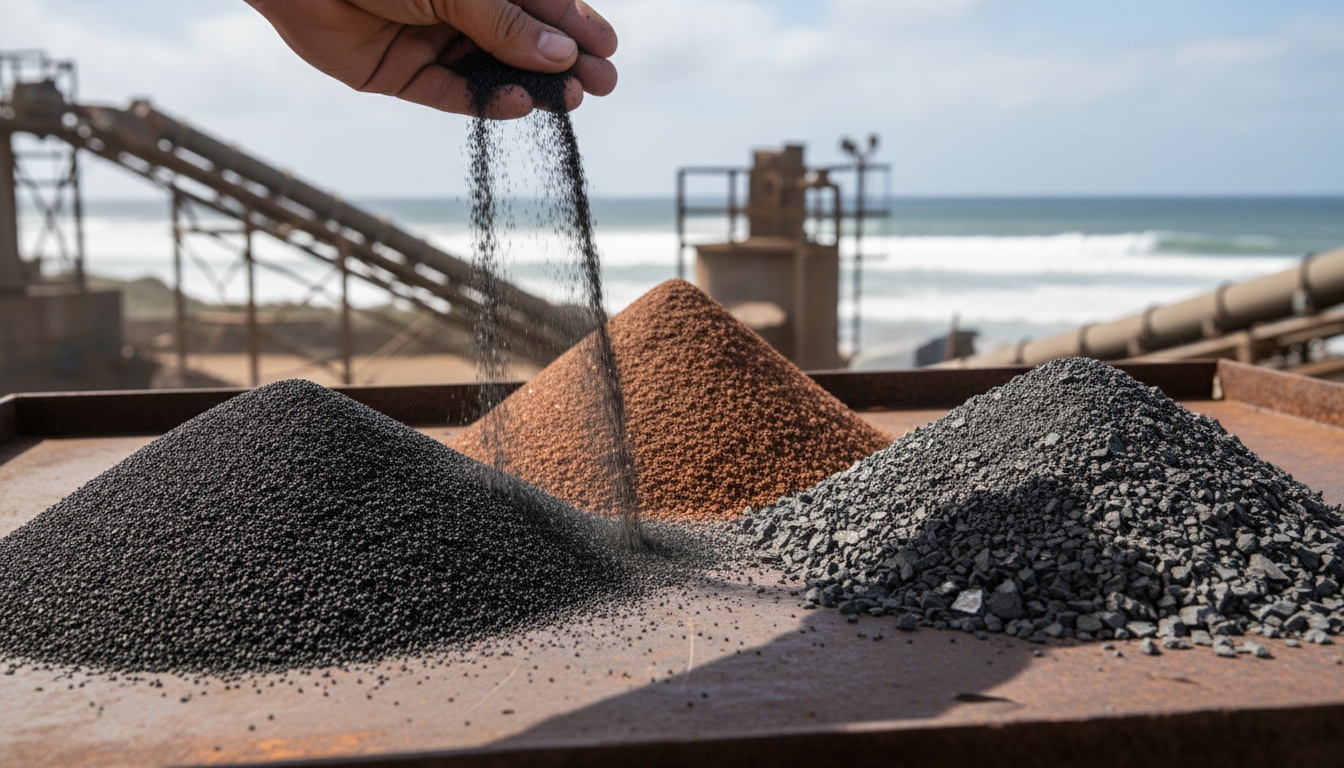
Titanium feedstocks under HS 2614.00 are sold on one number first, TiO₂, and on the impurities that decide which process can use them. The mineral-sands consultant TZMI classes ilmenite at 45–58% TiO₂ as sulphate ilmenite and at 58–65% as chloride ilmenite. Sulphate-route pigment plants digest ilmenite and sulphate slag in acid; chloride-route plants run fluidised-bed chlorinators that need high-TiO₂ feed such as chloride slag (around 85% TiO₂), synthetic rutile (above 90%) and natural rutile (90% and above). Leucoxene is ilmenite that groundwater has naturally leached of iron, which raises its TiO₂, and it goes to chloride pigment and to synthetic rutile kilns. Calcium and magnesium are policed hardest on chloride feed, because their chlorides boil high and clog the bed and the ducting; a common limit is CaO plus MgO not above 1.2%, or CaO not above 0.2% and MgO not above 1.0%. Rock ilmenite differs again: the Tellnes mine in Norway produces about 500,000 MT a year of concentrate at 44–45% TiO₂ for sulphate plants. Sizing is set by the placer or the mill, moisture is stated on the certificate, and rutile also sells in bags to welding-electrode and titanium-sponge buyers.
The 2024 export declarations put HS 2614.00 at USD 1.96 billion across the reporters in the pull, led by South Africa (30.2%), Mozambique (17.8%), Senegal (8.2%), Madagascar (8.1%), Kenya (5.2%), Australia (4.6%) and India (3.4%). Supply dynamics are undergoing major geographic restructuring: Kenmare's Moma mine in Mozambique produced 842,300 MT of ilmenite in 2025 and is tracking over 1.1 million MT in 2026 total product shipments by drawing down finished concentrate inventory, Base Titanium permanently ceased extraction at Kwale in Kenya in late 2025 due to resource depletion, and Eramet's Grande Côte Operations (GCO) in Senegal continues heavy mineral concentrate dispatches through its dedicated terminal at the Port of Dakar. Crucially, following Western sanctions and aerospace supply chain realignment away from a sanctioned state-backed producer, Western aerospace primes and specialty melt shops have redirected titanium sponge procurement to Japanese (Toho Titanium, Osaka Titanium Technologies / OTC) and U.S. (TIMET) facilities, triggering elevated demand for certified non-sanctioned natural rutile (≥ 95% TiO₂) and chloride-route titanium slag. Indian beach-sand minerals, including ilmenite, rutile, leucoxene and zircon, are exported through Indian Rare Earths Limited as the canalising state trading enterprise, so an Indian parcel carries that route or it does not ship. CBIL is a commodity brokerage company and brokers titanium minerals between producers and trader allocations on one side and pigment, slag, welding-flux, titanium-sponge and ferro-titanium plants on the other, in bulk vessel lots or 1–1.5 MT jumbo bags in containers, on FOB, CFR and CIF terms. Offers stand against an SGS, Bureau Veritas or Intertek analysis of TiO₂, Fe, CaO, MgO, Cr₂O₃, P₂O₅, U+Th and size, with a certificate of origin and a safety data sheet; Fastmarkets publishes monthly reference assessments for ilmenite concentrate 47–49% TiO₂ cif China and rutile 95% TiO₂ min fob Australia. Send the grade, the process route and the discharge port, and the enquiry is screened and worked against it.
Need the ship as well? Our chartering desk prices Norway to India olivine sand freight on LaycanDesk.
Excluded origins are not offered, including product re-exported, blended or re-processed through a third country. Every lot moves with a certificate of origin naming the producing plant, mine or grower country, and nothing is quoted before the seller and loading point are known.
Indicative reference
Per MT, on grade USD / MT
as at September 2026
Reference level only — not an offer, and reviewed quarterly. Levels shown are as at September 2026. Firm pricing is quoted per RFQ, subject to volume, terms and inspection.
Typical Specification
Specifications are indicative and adjusted to the agreed contract and destination requirements. Final spec confirmed on COA / SGS.
Available Grades
Applications
- Sulphate-process TiO₂ pigment
- Chloride-process TiO₂ pigment
- Titanium slag and synthetic rutile production
- Welding-electrode flux coatings (rutile)
- Titanium sponge and metal
- Ferro-titanium and steel
Category
Industrial Minerals & Construction
Incoterms
FOB · CFR · CIF
Pricing basis
USD / MT
Inspection
SGS / Intertek at load port
Titanium Minerals (Ilmenite, Rutile & Titanium Slag) — buyer questions
What separates sulphate ilmenite from chloride ilmenite?
TiO₂ content and impurities. TZMI classes ilmenite at 45–58% TiO₂ as sulphate ilmenite and 58–65% as chloride ilmenite. Sulphate pigment plants digest the mineral in acid and tolerate lower grades; chloride plants run fluidised-bed chlorinators and need high-TiO₂ feed with calcium and magnesium held down, commonly CaO plus MgO not above 1.2%.
Which origins export the most titanium ore?
The 2024 export declarations for HS 2614.00 total USD 1.96 billion in the reporters pulled, with South Africa at 30.2%, Mozambique 17.8%, Senegal 8.2%, Madagascar 8.1%, Kenya 5.2%, Australia 4.6% and India 3.4%. Kenya's share came from Base Titanium's Kwale mine, which ended operations in 2025.
How does CBIL support aerospace titanium supply chains bypassing sanctioned-origin feedstock?
Western aerospace manufacturers and melt shops transitioning away from sanctioned-origin integrated producer VSMPO-Avisma require certified non-sanctioned titanium sponge feedstocks. CBIL brokers high-purity natural rutile (≥ 95% TiO₂) and chloride titanium slag originating from Kenmare (Mozambique), Eramet Grande Côte (Senegal), and Australian mineral-sands producers. Shipments are qualified for vacuum-arc remelting (VAR) and electron-beam melting (EBM) titanium sponge plants in Japan, the EU, and North America, backed by full trace-element assays (U+Th, Fe, Cr, V) and clean non-sanctioned origin documentation.
Can ilmenite be bought from India?
Indian beach-sand minerals, including ilmenite, rutile, leucoxene and zircon, are exported through Indian Rare Earths Limited as the canalising state trading enterprise. An Indian offer therefore has to carry that export route; one that does not is not worked.
What documents come with a parcel?
An SGS, Bureau Veritas or Intertek certificate of analysis covering TiO₂, iron, CaO, MgO, Cr₂O₃, P₂O₅, radioactivity (U+Th) where the buyer or destination asks for it, and size distribution, plus a certificate of origin, a safety data sheet, the bill of lading and any export authorisation the origin requires.
How is titanium feedstock priced?
By negotiated contract on grade, per cargo or on term. Fastmarkets publishes monthly reference assessments for ilmenite concentrate 47–49% TiO₂ cif China and rutile 95% TiO₂ min fob Australia, which buyers use as a benchmark; the contract price is then adjusted for TiO₂ and impurities.
Ready to source Ilmenite & Rutile?
Send your quantity, specification, preferred Incoterms and destination port. Qualified requirements receive a workable offer against verified supply.
Have Ilmenite & Rutile to sell? Submit an offer — we'll match it against live buyer demand.
More in Industrial Minerals
Bentonite (API 13A Drilling, Foundry & Civil Piling Grades)
High-yield sodium and activated bentonite — API 13A oilfield, green sand foundry & diaphragm piling
Zircon Sand & Zircon Flour
Premium, standard and ceramic-grade zircon sand and milled flour by ZrO₂+HfO₂, iron and titanium
Drilling-Grade Barite (API 13A)
API 13A barite at 4.10 and 4.20 specific gravity, lumps and ground powder
Silica Sand & Quartz (Glass, Foundry, Frac, High-Purity)
Glass, foundry and frac sand and quartz, bought on SiO₂, iron and grain size
Kaolin & Ball Clay
Paper coating and filler kaolin, calcined kaolin and ceramic ball clay by brightness and particle size
Feldspar & Nepheline Syenite
Sodium and potassium feldspar and nepheline syenite by alkali, alumina and iron
Olivine Sand & Lump Flux
Natural magnesium iron silicate rock and sand for blast furnace slag conditioning, foundry sand and refractories
High-Purity Quartz (HPQ 4N8 / 5N & Crucible Sand)
HPQ 4N to 5N granular sand and lump for solar CZ crucibles and semiconductor wafer pulling
Activated Carbon (Coconut-Shell, Coal-Based & Wood)
Granular, powdered and extruded activated carbon bought on iodine number, CTC, hardness and mesh
Talc (Paint, Ceramic, Paper, Polymer & Cosmetic Grades)
Lump and micronised talc by brightness, particle size and asbestos-free certification
Perlite & Vermiculite (Crude Ore and Expanded)
Crude perlite ore, crude vermiculite concentrate and expanded grades for horticulture, construction and filter aids
Silicon Carbide (Black & Green, Metallurgical, Abrasive & Refractory)
Black and green SiC as metallurgical lumps, FEPA-graded abrasive grain and refractory aggregate
Borates (Colemanite, Ulexite, Boric Acid & Borax Pentahydrate)
Ground and granular colemanite, ulexite, boric acid and borax pentahydrate sold on B₂O₃ content
Garnet Sand (Blasting & Waterjet Grades)
Almandine garnet for abrasive blasting and waterjet cutting, sold by mesh cut and origin
Wollastonite, Kyanite & Mica (Ceramic, Refractory & Filler Minerals)
Acicular wollastonite, kyanite-group refractory minerals and muscovite and phlogopite mica for ceramics, refractories and fillers