
Talc (Paint, Ceramic, Paper, Polymer & Cosmetic Grades)
Lump and micronised talc by brightness, particle size and asbestos-free certification
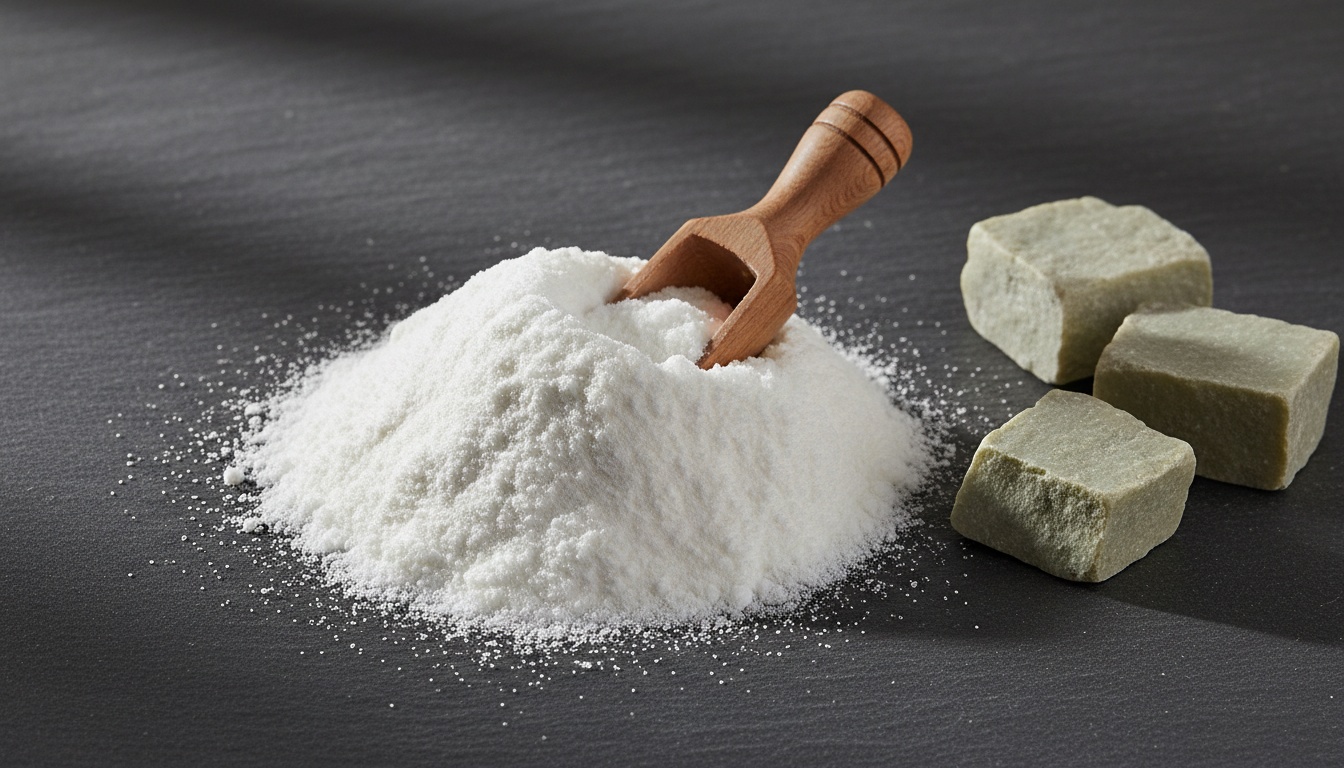
Talc, hydrous magnesium silicate under HS 2526 (2526.10 lump, 2526.20 crushed or powdered), is the softest mineral on the Mohs scale at 1 and is bought for softness, whiteness, platy shape and chemical inertness. ISO 3262 sets quality grades A to D on minimum talc content (50–95%), loss on ignition and HCl-soluble matter, and on top of that each end use adds its own numbers: brightness and particle size for paint and paper fillers, lamellarity and top cut for polymer compounding, where talc is compounded at roughly 0.5–40% by weight to raise stiffness and heat resistance, fired colour and shrinkage for ceramic bodies and glazes, and heavy-metal and microbiological limits for cosmetic and pharmaceutical grades. Because talc deposits can sit next to asbestiform minerals, every cosmetic, pharmaceutical and food-contact lot carries an asbestos test report from an ISO 17025 laboratory by transmission electron microscopy or polarised-light microscopy, and industrial buyers increasingly ask for the same. The regulatory picture is moving: on 9 July 2025 ECHA's Risk Assessment Committee issued a final opinion recommending talc be classified as a Category 1B carcinogen and STOT RE 1 under the EU CLP Regulation, which, once adopted, would trigger the automatic cosmetic prohibition under Article 15 of Regulation (EC) 1223/2009 unless an exemption is granted. Industrial talc is unaffected by that route but will carry the new labelling.
USGS reports Pakistan as the ninth-ranked producer of talc and related materials in 2024 at an estimated 230,000 MT, about 3.1% of world output, from deposits across Khyber Pakhtunkhwa (Sherwan in Hazara, Swat, Jamrud, Kurram and Landi Kotal), Balochistan and Gilgit-Baltistan; Pakistan was the largest source of US talc imports in 2020–23 at 51%, falling to about 33% in 2023. UN Comtrade 2024 export declarations for lump talc under HS 2526.10 put the trade at USD 106 million across the reporters in the pull, led by the United States (32.1%), India (20.9%, 124,254 MT), China (19.8%, 100,690 MT), Pakistan (8.6%, 50,061 MT), Australia (8.2%) and France (4.5%). China is the largest producer overall, with Brazil, India, the United States, France, Finland and Italy the other established sources. CBIL is a commodity brokerage company and brokers talc between miners, millers and trader allocations on one side and plastics compounders, paint, paper, ceramic, cosmetic and pharmaceutical plants on the other, as lumps in bulk or jumbo bags and as powder in 25 kg bags and 1–1.5 MT jumbo bags in containers, on FOB, CFR and CIF terms. Offers stand against an SGS, Bureau Veritas or Intertek analysis of talc content, brightness, particle-size distribution or D50, loss on ignition, Fe₂O₃ and CaO, an asbestos report where the grade requires it, a certificate of origin and a safety data sheet. Price is negotiated per lot on grade, fineness and origin. Send the application, the brightness and top cut required and the discharge port, and the enquiry is screened and worked against it.
Need the ship as well? Our chartering desk prices Norway to India olivine sand freight on LaycanDesk.
Excluded origins are not offered, including product re-exported, blended or re-processed through a third country. Every lot moves with a certificate of origin naming the producing plant, mine or grower country, and nothing is quoted before the seller and loading point are known.
Indicative reference
Per MT, on grade and fineness USD / MT
as at September 2026
Reference level only — not an offer, and reviewed quarterly. Levels shown are as at September 2026. Firm pricing is quoted per RFQ, subject to volume, terms and inspection.
Typical Specification
Specifications are indicative and adjusted to the agreed contract and destination requirements. Final spec confirmed on COA / SGS.
Available Grades
Applications
- Polypropylene and engineering-plastic compounding
- Paint, primers and powder coatings
- Paper filler and pitch control
- Ceramic tiles, sanitaryware and cordierite
- Cosmetics and pharmaceuticals (certified grades)
- Rubber, roofing and agricultural carriers
Category
Industrial Minerals & Construction
Incoterms
FOB · CFR · CIF
Pricing basis
USD / MT
Inspection
SGS / Intertek at load port
Talc (Paint, Ceramic, Paper, Polymer & Cosmetic Grades) — buyer questions
What decides a talc grade?
ISO 3262 sets grades A to D on minimum talc content (50–95%), loss on ignition and HCl-soluble matter. On top of that, paint and paper buy on brightness and particle size, polymer compounders on lamellarity and top cut, ceramic plants on fired colour and shrinkage, and cosmetic and pharmaceutical buyers on heavy metals, microbiology and an asbestos-free test report.
Is Pakistani talc a real source?
Yes. USGS puts Pakistan ninth in world talc and related-materials production in 2024 at an estimated 230,000 MT, about 3.1% of world output, and Pakistan supplied 51% of US talc imports in 2020–23. Deposits sit in Khyber Pakhtunkhwa (Sherwan, Swat, Jamrud, Kurram, Landi Kotal), Balochistan and Gilgit-Baltistan.
How is asbestos ruled out?
By a test report from an ISO 17025 accredited laboratory using transmission electron microscopy or polarised-light microscopy, which is standard on every cosmetic, pharmaceutical and food-contact lot and increasingly requested by industrial buyers. The report travels with the certificate of analysis.
What is changing in EU regulation of talc?
On 9 July 2025 ECHA's Risk Assessment Committee issued a final opinion recommending classification of talc as a Category 1B carcinogen and STOT RE 1 under the CLP Regulation. If adopted, CMR 1B status prohibits the substance in cosmetics under Article 15 of Regulation (EC) 1223/2009 unless an exemption is granted; industrial uses continue with revised labelling.
Which countries export lump talc?
UN Comtrade 2024 export declarations for HS 2526.10 total USD 106 million in the reporters pulled: the United States 32.1%, India 20.9%, China 19.8%, Pakistan 8.6%, Australia 8.2% and France 4.5%. By weight India (124,254 MT), China (100,690 MT) and Pakistan (50,061 MT) lead.
Ready to source Talc?
Send your quantity, specification, preferred Incoterms and destination port. Qualified requirements receive a workable offer against verified supply.
Have Talc to sell? Submit an offer — we'll match it against live buyer demand.
More in Industrial Minerals
Bentonite (API 13A Drilling, Foundry & Civil Piling Grades)
High-yield sodium and activated bentonite — API 13A oilfield, green sand foundry & diaphragm piling
Titanium Minerals (Ilmenite, Rutile & Titanium Slag)
Sulphate and chloride ilmenite, natural and synthetic rutile, leucoxene and slag by TiO₂ content
Zircon Sand & Zircon Flour
Premium, standard and ceramic-grade zircon sand and milled flour by ZrO₂+HfO₂, iron and titanium
Drilling-Grade Barite (API 13A)
API 13A barite at 4.10 and 4.20 specific gravity, lumps and ground powder
Silica Sand & Quartz (Glass, Foundry, Frac, High-Purity)
Glass, foundry and frac sand and quartz, bought on SiO₂, iron and grain size
Kaolin & Ball Clay
Paper coating and filler kaolin, calcined kaolin and ceramic ball clay by brightness and particle size
Feldspar & Nepheline Syenite
Sodium and potassium feldspar and nepheline syenite by alkali, alumina and iron
Olivine Sand & Lump Flux
Natural magnesium iron silicate rock and sand for blast furnace slag conditioning, foundry sand and refractories
High-Purity Quartz (HPQ 4N8 / 5N & Crucible Sand)
HPQ 4N to 5N granular sand and lump for solar CZ crucibles and semiconductor wafer pulling
Activated Carbon (Coconut-Shell, Coal-Based & Wood)
Granular, powdered and extruded activated carbon bought on iodine number, CTC, hardness and mesh
Perlite & Vermiculite (Crude Ore and Expanded)
Crude perlite ore, crude vermiculite concentrate and expanded grades for horticulture, construction and filter aids
Silicon Carbide (Black & Green, Metallurgical, Abrasive & Refractory)
Black and green SiC as metallurgical lumps, FEPA-graded abrasive grain and refractory aggregate
Borates (Colemanite, Ulexite, Boric Acid & Borax Pentahydrate)
Ground and granular colemanite, ulexite, boric acid and borax pentahydrate sold on B₂O₃ content
Garnet Sand (Blasting & Waterjet Grades)
Almandine garnet for abrasive blasting and waterjet cutting, sold by mesh cut and origin
Wollastonite, Kyanite & Mica (Ceramic, Refractory & Filler Minerals)
Acicular wollastonite, kyanite-group refractory minerals and muscovite and phlogopite mica for ceramics, refractories and fillers