
Garnet Sand (Blasting & Waterjet Grades)
Almandine garnet for abrasive blasting and waterjet cutting, sold by mesh cut and origin
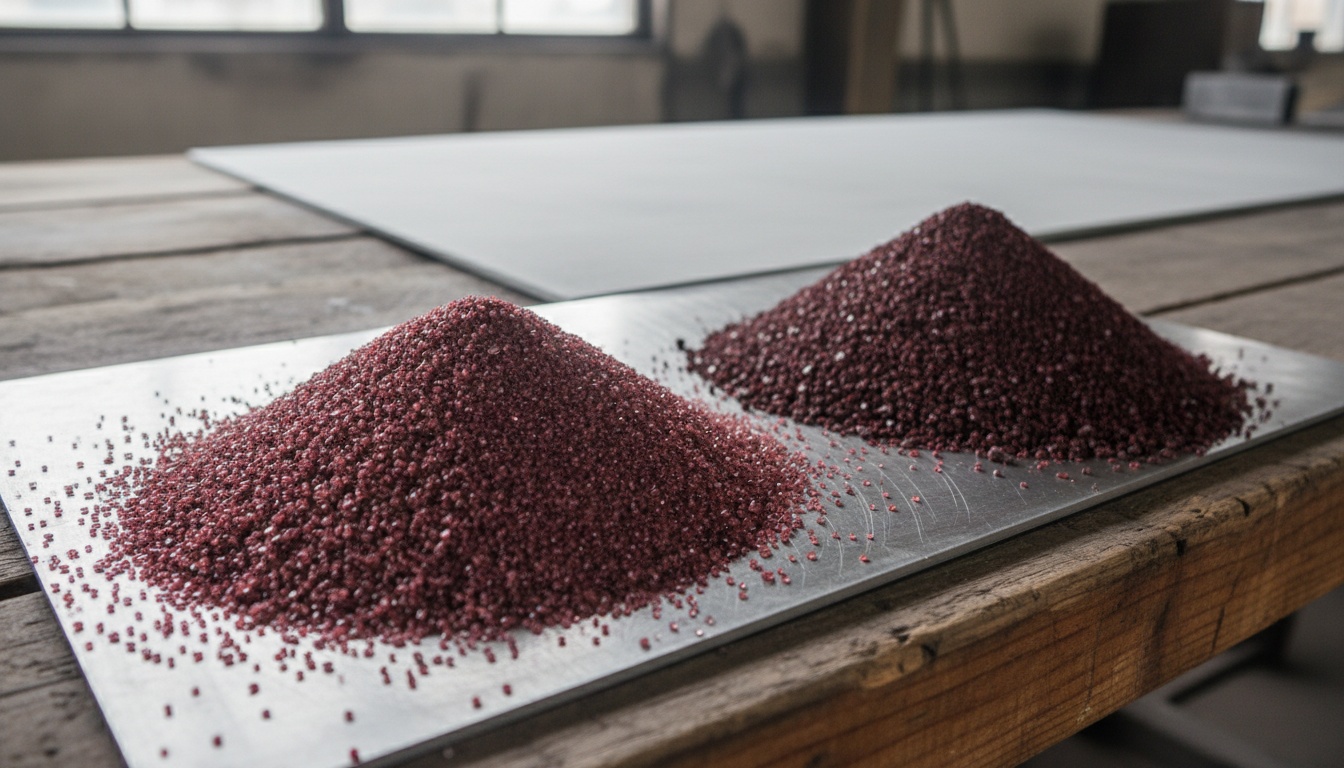
Industrial garnet under HS 2513.20 is almost all almandine, an iron-aluminium garnet of Mohs hardness 7.5–8.5 and specific gravity about 4.1, and it replaced silica sand in blasting because it is hard, heavy, chemically inert and free of respirable free silica. The trade sorts it by particle size and by how it was formed. Grains coarser than 60 mesh (250 microns) go to abrasive blasting; 60–200 mesh (250–74 microns), the band that holds the common 80 mesh waterjet cut, goes to abrasive waterjet cutting; and finer than 200 mesh goes to glass polishing, lapping and garnet paper. Alluvial and beach-sand garnet is rounder and suits blasting; hard-rock garnet crushed from gneiss and schist is angular and cuts faster in a waterjet head. Australia and India hold the largest beach and river deposits, with rock garnet mined in the United States, China and western India. Each lot is sold on sieve analysis to the mesh cut ordered, with bulk density, moisture, conductivity or chloride and free-silica figures on the certificate, because a salt-bearing garnet flash-rusts freshly blasted steel and a silica-bearing one puts the blasting crew inside the respirable silica rules.
India's garnet is a controlled export. DGFT Notification No. 26/2015-2020 of 21 August 2018 placed beach-sand minerals under Chapter 26 of the ITC (HS), including garnet under 2513 20 30, on the State Trading Enterprise list, canalised through Indian Rare Earths Limited; on 24 December 2025 the Ahmedabad bench of CESTAT held in Payal Synthetics v. Commissioner of Customs, Ahmedabad, that the restriction applies to garnet irrespective of source, inland-mined as well as beach, because of the tariff heading and the potential rare-earth content. An Indian garnet offer therefore carries the IREL route or it does not ship, and CBIL works it on that basis. USGS ranks Pakistan seventh in world garnet production in 2024, and Australia, China and South Africa are the other established origins. CBIL is a commodity brokerage company and brokers garnet between mines, mineral-sands operators and trader allocations on one side and blasting contractors, shipyards, waterjet shops, abrasive distributors and water-filtration plants on the other, in 25 kg bags and 1 MT jumbo bags in containers or bulk vessel lots, on FOB, CFR and CIF terms. Offers stand against an SGS, Bureau Veritas or Intertek report giving sieve analysis, garnet content, specific gravity, bulk density, moisture, conductivity or chloride and free silica, a certificate of origin and a safety data sheet. Price is negotiated per lot on mesh cut and origin. Send the application, the mesh and the discharge port, and the enquiry is screened and worked against it.
Need the ship as well? Our chartering desk prices Norway to India olivine sand freight on LaycanDesk.
Excluded origins are not offered, including product re-exported, blended or re-processed through a third country. Every lot moves with a certificate of origin naming the producing plant, mine or grower country, and nothing is quoted before the seller and loading point are known.
Indicative reference
Per MT, on mesh and origin USD / MT
as at September 2026
Reference level only — not an offer, and reviewed quarterly. Levels shown are as at September 2026. Firm pricing is quoted per RFQ, subject to volume, terms and inspection.
Typical Specification
Specifications are indicative and adjusted to the agreed contract and destination requirements. Final spec confirmed on COA / SGS.
Available Grades
Applications
- Abrasive blasting of steel, ships and tanks
- Abrasive waterjet cutting of metal, stone and glass
- Water-filtration media
- Glass polishing, lapping and garnet paper
- Anti-slip surfaces and coatings
Category
Industrial Minerals & Construction
Incoterms
FOB · CFR · CIF
Pricing basis
USD / MT
Inspection
SGS / Intertek at load port
Garnet Sand (Blasting & Waterjet Grades) — buyer questions
Which mesh do I need for blasting versus waterjet?
Blasting uses grains coarser than 60 mesh (250 microns), with 30/60 a common cut; waterjet cutting uses 60–200 mesh (250–74 microns), where 80 mesh is the usual choice. Finer than 200 mesh goes to glass polishing and lapping. Coarser grain works faster, finer grain gives a finer finish and a narrower kerf.
Why does the deposit type matter?
Alluvial and beach-sand garnet has rounded grains that suit blasting and recycle well; hard-rock garnet crushed from gneiss and schist is angular and cuts faster in a waterjet head. Australia and India hold the largest beach and river deposits, and rock garnet is mined in the United States, China and western India.
Can garnet be bought from India?
Only through Indian Rare Earths Limited. DGFT Notification 26/2015-2020 of 21 August 2018 canalised beach-sand minerals including garnet (2513 20 30) through IREL, and on 24 December 2025 CESTAT Ahmedabad held in Payal Synthetics v. Commissioner of Customs that the restriction applies to garnet irrespective of source, inland or beach. An Indian offer carries that route or it is not worked.
What contaminant limits matter?
Water-soluble salts, read as conductivity or chloride, because salt left on blasted steel flash-rusts under the coating; free crystalline silica, because a silica-bearing abrasive brings respirable-silica exposure rules onto the job; and heavy-metal content where the destination regulates blasting media. Each is stated on the certificate.
Ready to source Garnet Sand?
Send your quantity, specification, preferred Incoterms and destination port. Qualified requirements receive a workable offer against verified supply.
Have Garnet Sand to sell? Submit an offer — we'll match it against live buyer demand.
More in Industrial Minerals
Bentonite (API 13A Drilling, Foundry & Civil Piling Grades)
High-yield sodium and activated bentonite — API 13A oilfield, green sand foundry & diaphragm piling
Titanium Minerals (Ilmenite, Rutile & Titanium Slag)
Sulphate and chloride ilmenite, natural and synthetic rutile, leucoxene and slag by TiO₂ content
Zircon Sand & Zircon Flour
Premium, standard and ceramic-grade zircon sand and milled flour by ZrO₂+HfO₂, iron and titanium
Drilling-Grade Barite (API 13A)
API 13A barite at 4.10 and 4.20 specific gravity, lumps and ground powder
Silica Sand & Quartz (Glass, Foundry, Frac, High-Purity)
Glass, foundry and frac sand and quartz, bought on SiO₂, iron and grain size
Kaolin & Ball Clay
Paper coating and filler kaolin, calcined kaolin and ceramic ball clay by brightness and particle size
Feldspar & Nepheline Syenite
Sodium and potassium feldspar and nepheline syenite by alkali, alumina and iron
Olivine Sand & Lump Flux
Natural magnesium iron silicate rock and sand for blast furnace slag conditioning, foundry sand and refractories
High-Purity Quartz (HPQ 4N8 / 5N & Crucible Sand)
HPQ 4N to 5N granular sand and lump for solar CZ crucibles and semiconductor wafer pulling
Activated Carbon (Coconut-Shell, Coal-Based & Wood)
Granular, powdered and extruded activated carbon bought on iodine number, CTC, hardness and mesh
Talc (Paint, Ceramic, Paper, Polymer & Cosmetic Grades)
Lump and micronised talc by brightness, particle size and asbestos-free certification
Perlite & Vermiculite (Crude Ore and Expanded)
Crude perlite ore, crude vermiculite concentrate and expanded grades for horticulture, construction and filter aids
Silicon Carbide (Black & Green, Metallurgical, Abrasive & Refractory)
Black and green SiC as metallurgical lumps, FEPA-graded abrasive grain and refractory aggregate
Borates (Colemanite, Ulexite, Boric Acid & Borax Pentahydrate)
Ground and granular colemanite, ulexite, boric acid and borax pentahydrate sold on B₂O₃ content
Wollastonite, Kyanite & Mica (Ceramic, Refractory & Filler Minerals)
Acicular wollastonite, kyanite-group refractory minerals and muscovite and phlogopite mica for ceramics, refractories and fillers