
High-Purity Quartz (HPQ 4N8 / 5N & Crucible Sand)
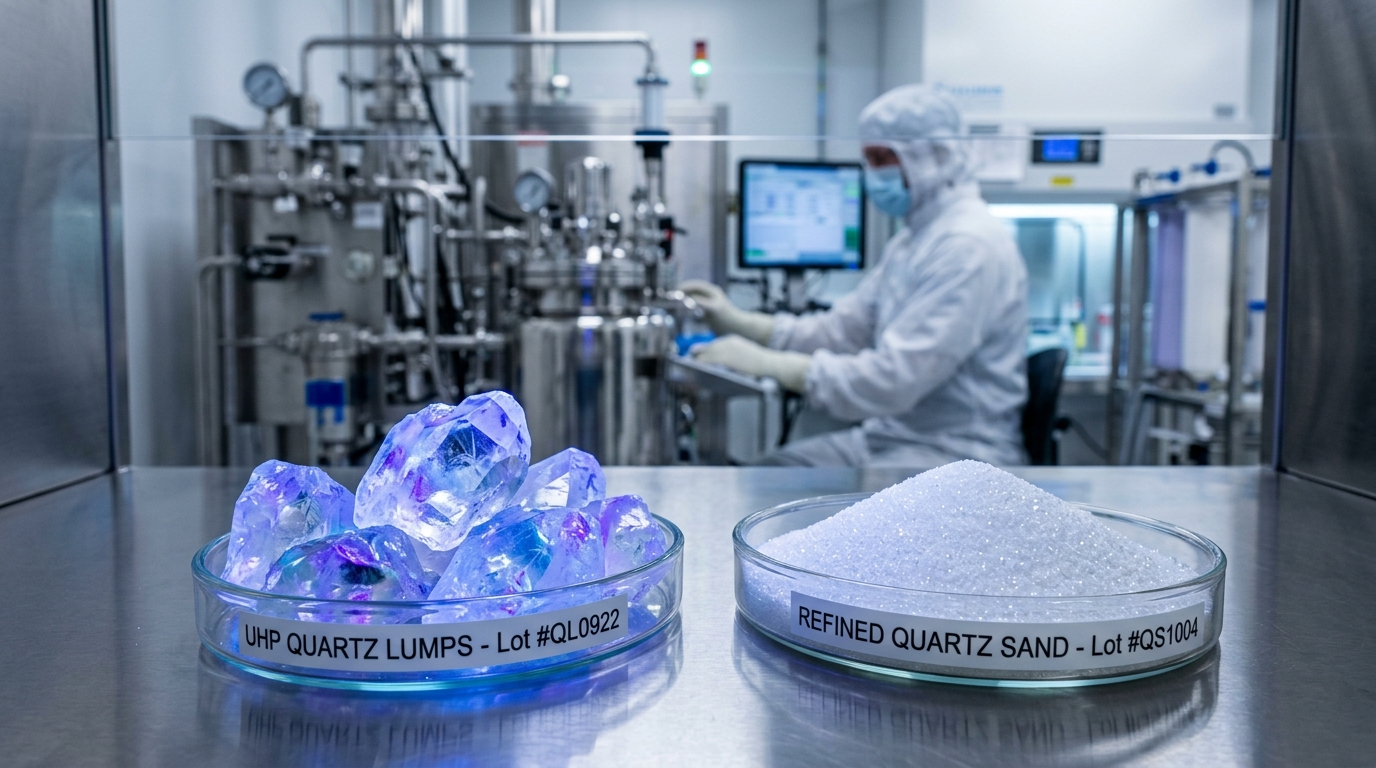
HPQ 4N to 5N granular sand and lump for solar CZ crucibles and semiconductor wafer pulling
High-Purity Quartz (HPQ) is the indispensable baseline for the semiconductor industry and advanced monocrystalline solar photovoltaics. Every single-crystal silicon ingot grown for microprocessors, memory chips, and high-efficiency N-type TOPCon and Heterojunction (HJT) solar cells relies on Czochralski (CZ) crystal pulling inside a rotational arc-fused silica quartz crucible at temperatures exceeding 1,450 °C. At these temperatures, molten polysilicon dissolves the crucible wall at 5 to 15 microns per hour. Any chemical impurities or micro-structural defects contained within the quartz migrate directly into the silicon melt: transition metals (Fe, Ti) act as deep-level recombination lifetime killers; alkalis (Li, Na, K) catalyze cristobalite devitrification and catastrophic melt spalling; and electrical dopants (B, P) destroy the targeted resistivity profile of N-type silicon.
Crucible performance requires two distinct quartz feedstocks: an opaque outer layer (60–70% of wall thickness, 4N to 4N5 sand, rich in 10–100 µm micro-bubbles that scatter infrared radiation to ensure uniform thermal distribution and prevent sagging) and a transparent, vitrified inner layer (20–30% of wall thickness, 4N8 to 5N sand fused under intense vacuum, completely bubble-free with < 0.05% vol gas voids). The inner layer contacts molten silicon for 150 to over 300 consecutive hours in modern Recharge Czochralski (RCZ) runs. For over four decades, global supply of inner-layer natural HPQ was concentrated in the Spruce Pine pegmatites of Mitchell County, North Carolina (Sibelco IOTA® and The Quartz Corp), supplying > 70–80% of world demand. Following the devastating infrastructure disruption caused by Hurricane Helene in late 2024, global wafer manufacturers initiated mandatory qualification of non-US HPQ corridors.
CBIL brokers verified HPQ granular sand and feedstock lump from accredited global corridors: Drag pegmatite refining operations in Northern Norway; advanced hydrothermal vein quartz deposits in the Dharwar and Aravalli cratons of India (Andhra Pradesh, Telangana, Rajasthan) beneficiated via thermal decrepitation, HGMS, and hot acid pressure leaching; low-boron pegmatitic lasca from Bahia and Minas Gerais, Brazil; and emerging projects in Australia (Sugarbag Hill) and Canada. Granular sand is sized to 100–400 µm (d50 200–250 µm) with moisture ≤ 0.05%, packed in Class 1,000 cleanrooms into 1,000 kg hermetic EVOH moisture-barrier big bags backfilled with dry nitrogen, and shipped 20 MT per 20ft container. Offers stand against certified GD-MS or ICP-MS elemental assays, laser diffraction PSD, and crucible fusion trial performance.
Need the ship as well? Our chartering desk prices Norway to India olivine sand freight on LaycanDesk.
Excluded origins are not offered, including product re-exported, blended or re-processed through a third country. Every lot moves with a certificate of origin naming the producing plant, mine or grower country, and nothing is quoted before the seller and loading point are known.
Indicative reference
$3,500–$18,000 USD / MT
as at September 2026
Reference level only — not an offer, and reviewed quarterly. Levels shown are as at September 2026. Firm pricing is quoted per RFQ, subject to volume, terms and inspection.
Typical Specification
Specifications are indicative and adjusted to the agreed contract and destination requirements. Final spec confirmed on COA / SGS.
Available Grades
Applications
- Czochralski (CZ) quartz crucibles (inner & outer layers)
- N-Type TOPCon, HJT & IBC solar wafer ingot pulling
- Semiconductor monocrystalline silicon crystal pulling (300mm/450mm)
- Semiconductor quartzware: diffusion tubes, boats & etch chambers
- High-end optical fiber preforms & UV lithography optics
Category
Industrial Minerals & Construction
Incoterms
FOB · CFR · CIF
Pricing basis
USD / MT
Inspection
SGS / Intertek at load port
High-Purity Quartz (HPQ 4N8 / 5N & Crucible Sand) — buyer questions
What is the difference between inner-layer and outer-layer quartz crucible sand?
The outer layer (60–70% of wall thickness) uses 4N/4N5 natural sand and is deliberately fused with micro-bubbles to scatter infrared radiation from external heaters, ensuring uniform heat distribution and structural rigidity. The inner layer (20–30% of wall thickness) uses ultra-pure 4N8 or 5N sand fused under deep vacuum to be completely bubble-free. Because the inner layer dissolves into the silicon melt at 5–15 µm/hr at 1,450 °C, it must be exceptionally pure to prevent dislocations, cristobalite spalling, or lifetime-killing metal contamination.
Why is Spruce Pine, North Carolina considered a global chokepoint?
The Spruce Pine pegmatites feature coarse, segregated quartz crystals with near-zero lattice defects (substitutional Al < 10 ppm, Ti < 1.5 ppm, Fe < 0.5 ppm) and minimal fluid inclusions. Sibelco and The Quartz Corp supply over 70–80% of the world's solar and semiconductor crucible sand from this single Appalachian valley. The late-2024 Hurricane Helene disaster severed regional roads, rail, and water lines, triggering emergency qualification of non-US deposits across Norway, India, and Brazil.
How does impurity chemistry affect N-type solar wafer manufacturing?
Older P-type PERC cells required minority carrier lifetimes of 300–500 µs. Modern N-type TOPCon and HJT cells require carrier lifetimes > 1,500–3,500 µs to reach > 25.5% efficiency. Trace iron, titanium, or copper leaching from the crucible destroys carrier lifetime, while boron leached into phosphorus-doped N-type silicon causes uncontrollable electrical resistivity compensation and severe efficiency losses.
How is high-purity quartz sand packaged to prevent contamination in transit?
HPQ sand is packaged inside Class 1,000 or Class 10,000 cleanrooms into 1,000 kg Flexible Intermediate Bulk Containers (FIBCs) featuring an inner EVOH or aluminum foil moisture-barrier liner. Bags are evacuated, backfilled with dry ultra-pure nitrogen (N₂) gas, and hermetically heat-sealed. Pallets are shrink-wrapped and loaded 20 MT (20 bags) per 20ft container to prevent ambient moisture, dust, or airborne salt penetration.
Ready to source High-Purity Quartz?
Send your quantity, specification, preferred Incoterms and destination port. Qualified requirements receive a workable offer against verified supply.
Have High-Purity Quartz to sell? Submit an offer — we'll match it against live buyer demand.
More in Industrial Minerals
Bentonite (API 13A Drilling, Foundry & Civil Piling Grades)
High-yield sodium and activated bentonite — API 13A oilfield, green sand foundry & diaphragm piling
Titanium Minerals (Ilmenite, Rutile & Titanium Slag)
Sulphate and chloride ilmenite, natural and synthetic rutile, leucoxene and slag by TiO₂ content
Zircon Sand & Zircon Flour
Premium, standard and ceramic-grade zircon sand and milled flour by ZrO₂+HfO₂, iron and titanium
Drilling-Grade Barite (API 13A)
API 13A barite at 4.10 and 4.20 specific gravity, lumps and ground powder
Silica Sand & Quartz (Glass, Foundry, Frac, High-Purity)
Glass, foundry and frac sand and quartz, bought on SiO₂, iron and grain size
Kaolin & Ball Clay
Paper coating and filler kaolin, calcined kaolin and ceramic ball clay by brightness and particle size
Feldspar & Nepheline Syenite
Sodium and potassium feldspar and nepheline syenite by alkali, alumina and iron
Olivine Sand & Lump Flux
Natural magnesium iron silicate rock and sand for blast furnace slag conditioning, foundry sand and refractories
Activated Carbon (Coconut-Shell, Coal-Based & Wood)
Granular, powdered and extruded activated carbon bought on iodine number, CTC, hardness and mesh
Talc (Paint, Ceramic, Paper, Polymer & Cosmetic Grades)
Lump and micronised talc by brightness, particle size and asbestos-free certification
Perlite & Vermiculite (Crude Ore and Expanded)
Crude perlite ore, crude vermiculite concentrate and expanded grades for horticulture, construction and filter aids
Silicon Carbide (Black & Green, Metallurgical, Abrasive & Refractory)
Black and green SiC as metallurgical lumps, FEPA-graded abrasive grain and refractory aggregate
Borates (Colemanite, Ulexite, Boric Acid & Borax Pentahydrate)
Ground and granular colemanite, ulexite, boric acid and borax pentahydrate sold on B₂O₃ content
Garnet Sand (Blasting & Waterjet Grades)
Almandine garnet for abrasive blasting and waterjet cutting, sold by mesh cut and origin
Wollastonite, Kyanite & Mica (Ceramic, Refractory & Filler Minerals)
Acicular wollastonite, kyanite-group refractory minerals and muscovite and phlogopite mica for ceramics, refractories and fillers