
Silicon Carbide (Black & Green, Metallurgical, Abrasive & Refractory)
Black and green SiC as metallurgical lumps, FEPA-graded abrasive grain and refractory aggregate
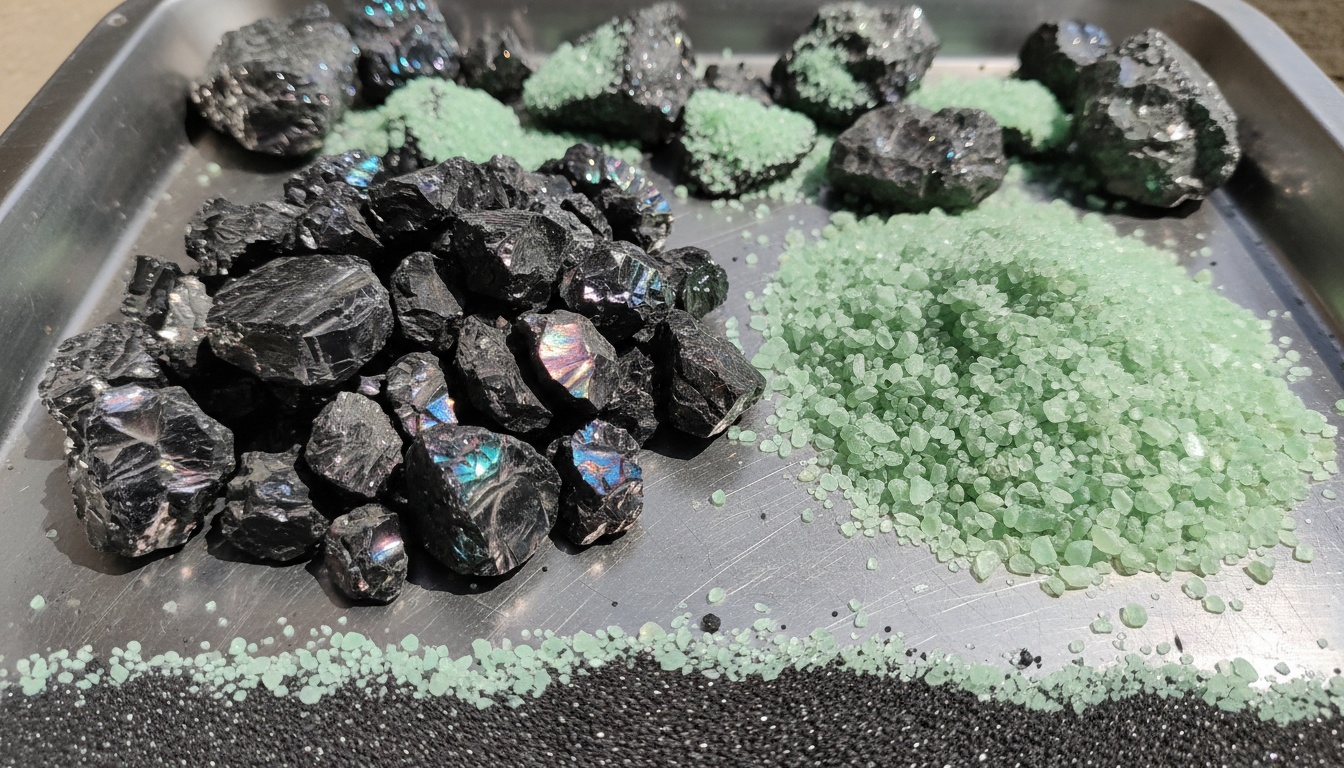
Silicon carbide under HS 2849.20 is made in the Acheson furnace, patented in 1893, by resistance-heating a bed of quartz sand and petroleum coke around a graphite core. Purity follows position in the furnace: the pale green crystals nearest the core are the purest, and the material grades to black and lower purity outward, which is why the trade splits into green SiC of up to 99.9% and black SiC of about 98–99% with iron, aluminium and free silicon as the impurities. Hardness is 9.2–9.4 on the Mohs scale, sublimation is at about 2,700°C, and the product is sold three ways. Metallurgical grade is the outer, lower-purity furnace material, crushed to lumps or granules and sold on SiC content for steelmaking, where it acts as a fuel and a silicon and carbon source in the basic oxygen furnace and electric arc furnace and lets a melt shop charge more scrap, and for iron foundries as an inoculant carrier and deoxidiser. Abrasive grade is crushed, washed and screened to the FEPA F scale, coarse F24–F80 for rough grinding and blasting, medium F100–F220 for finishing and micro-grits F400 and finer for lapping and polishing; black SiC goes into bonded wheels, coated abrasives and blasting, green SiC into precision lapping of carbides, ceramics and optics. Refractory grade is sized aggregate and fines for kiln furniture, bricks and castables, where coarse SiC gives thermal-shock resistance and wear strength.
USGS reports that China accounted for 94% of world crude silicon carbide production and 58% of ground and refined production in its 2025 summary, with the remaining furnaces in India, Brazil, Norway, the United States, Europe and Latin America serving regional abrasive and refractory demand and buyers who want a second origin. CBIL is a commodity brokerage company and brokers silicon carbide between furnace operators, processors and trader allocations on one side and steel mills, iron foundries, abrasive and refractory manufacturers on the other, in 25 kg bags and 1 MT jumbo bags in containers or bulk vessel lots for metallurgical lumps, on FOB, CFR and CIF terms. Offers stand against an SGS, Bureau Veritas or Intertek analysis of SiC, free carbon, Fe₂O₃, free silicon and SiO₂, with sieve analysis or FEPA grit certification and, for micro-grits, a particle-size distribution, plus a certificate of origin and a safety data sheet. Price is negotiated per lot on grade, SiC content and grit. Send the grade, the SiC content or F-number required and the discharge port, and the enquiry is screened and worked against it.
Need the ship as well? Our chartering desk prices Norway to India olivine sand freight on LaycanDesk.
Excluded origins are not offered, including product re-exported, blended or re-processed through a third country. Every lot moves with a certificate of origin naming the producing plant, mine or grower country, and nothing is quoted before the seller and loading point are known.
Indicative reference
Per MT, on grade and grit USD / MT
as at September 2026
Reference level only — not an offer, and reviewed quarterly. Levels shown are as at September 2026. Firm pricing is quoted per RFQ, subject to volume, terms and inspection.
Typical Specification
Specifications are indicative and adjusted to the agreed contract and destination requirements. Final spec confirmed on COA / SGS.
Available Grades
Applications
- Steelmaking (BOF and EAF) as silicon, carbon and fuel source
- Iron foundry deoxidiser and inoculant carrier
- Bonded and coated abrasives, blasting media
- Precision lapping and polishing of carbides, ceramics and optics
- Refractory bricks, castables and kiln furniture
- Wire sawing, wear parts and ceramic composites
Category
Industrial Minerals & Construction
Incoterms
FOB · CFR · CIF
Pricing basis
USD / MT
Inspection
SGS / Intertek at load port
Silicon Carbide (Black & Green, Metallurgical, Abrasive & Refractory) — buyer questions
What is the difference between black and green silicon carbide?
Purity, set by where the material forms in the Acheson furnace. Green SiC comes from nearest the graphite core at up to 99.9% SiC and is sharper and more friable, so it goes to precision lapping of carbides, ceramics and optics. Black SiC is about 98–99% with iron, aluminium and free silicon, tougher and cheaper, and goes to grinding wheels, coated abrasives, blasting and refractories.
What does a steel mill use silicon carbide for?
Dissolved in a basic oxygen or electric arc furnace it acts as a fuel and supplies silicon and carbon, which lets the shop charge more scrap and adjust melt chemistry. Metallurgical-grade SiC is the lower-purity outer furnace material, crushed to lumps or granules and sold on its SiC content as stated on the analysis.
How are abrasive grits specified?
On the FEPA F scale: F24–F80 coarse grits for rough grinding and blasting, F100–F220 medium grits for finishing, and F400 and finer micro-grits for lapping and polishing, down to sub-micron powders for optical work. Each lot carries a sieve or particle-size certificate against the F-number ordered.
Where does silicon carbide come from?
USGS puts China at 94% of world crude silicon carbide production and 58% of ground and refined production in its 2025 summary. India, Brazil and Norway run the main alternative furnaces, and buyers who want a second origin for abrasive or refractory grain look there first.
Ready to source Silicon Carbide?
Send your quantity, specification, preferred Incoterms and destination port. Qualified requirements receive a workable offer against verified supply.
Have Silicon Carbide to sell? Submit an offer — we'll match it against live buyer demand.
More in Industrial Minerals
Bentonite (API 13A Drilling, Foundry & Civil Piling Grades)
High-yield sodium and activated bentonite — API 13A oilfield, green sand foundry & diaphragm piling
Titanium Minerals (Ilmenite, Rutile & Titanium Slag)
Sulphate and chloride ilmenite, natural and synthetic rutile, leucoxene and slag by TiO₂ content
Zircon Sand & Zircon Flour
Premium, standard and ceramic-grade zircon sand and milled flour by ZrO₂+HfO₂, iron and titanium
Drilling-Grade Barite (API 13A)
API 13A barite at 4.10 and 4.20 specific gravity, lumps and ground powder
Silica Sand & Quartz (Glass, Foundry, Frac, High-Purity)
Glass, foundry and frac sand and quartz, bought on SiO₂, iron and grain size
Kaolin & Ball Clay
Paper coating and filler kaolin, calcined kaolin and ceramic ball clay by brightness and particle size
Feldspar & Nepheline Syenite
Sodium and potassium feldspar and nepheline syenite by alkali, alumina and iron
Olivine Sand & Lump Flux
Natural magnesium iron silicate rock and sand for blast furnace slag conditioning, foundry sand and refractories
High-Purity Quartz (HPQ 4N8 / 5N & Crucible Sand)
HPQ 4N to 5N granular sand and lump for solar CZ crucibles and semiconductor wafer pulling
Activated Carbon (Coconut-Shell, Coal-Based & Wood)
Granular, powdered and extruded activated carbon bought on iodine number, CTC, hardness and mesh
Talc (Paint, Ceramic, Paper, Polymer & Cosmetic Grades)
Lump and micronised talc by brightness, particle size and asbestos-free certification
Perlite & Vermiculite (Crude Ore and Expanded)
Crude perlite ore, crude vermiculite concentrate and expanded grades for horticulture, construction and filter aids
Borates (Colemanite, Ulexite, Boric Acid & Borax Pentahydrate)
Ground and granular colemanite, ulexite, boric acid and borax pentahydrate sold on B₂O₃ content
Garnet Sand (Blasting & Waterjet Grades)
Almandine garnet for abrasive blasting and waterjet cutting, sold by mesh cut and origin
Wollastonite, Kyanite & Mica (Ceramic, Refractory & Filler Minerals)
Acicular wollastonite, kyanite-group refractory minerals and muscovite and phlogopite mica for ceramics, refractories and fillers