
Armour Rock & Boulders
Graded armour rock and boulders for breakwaters, in Supramax lots and on deck barges
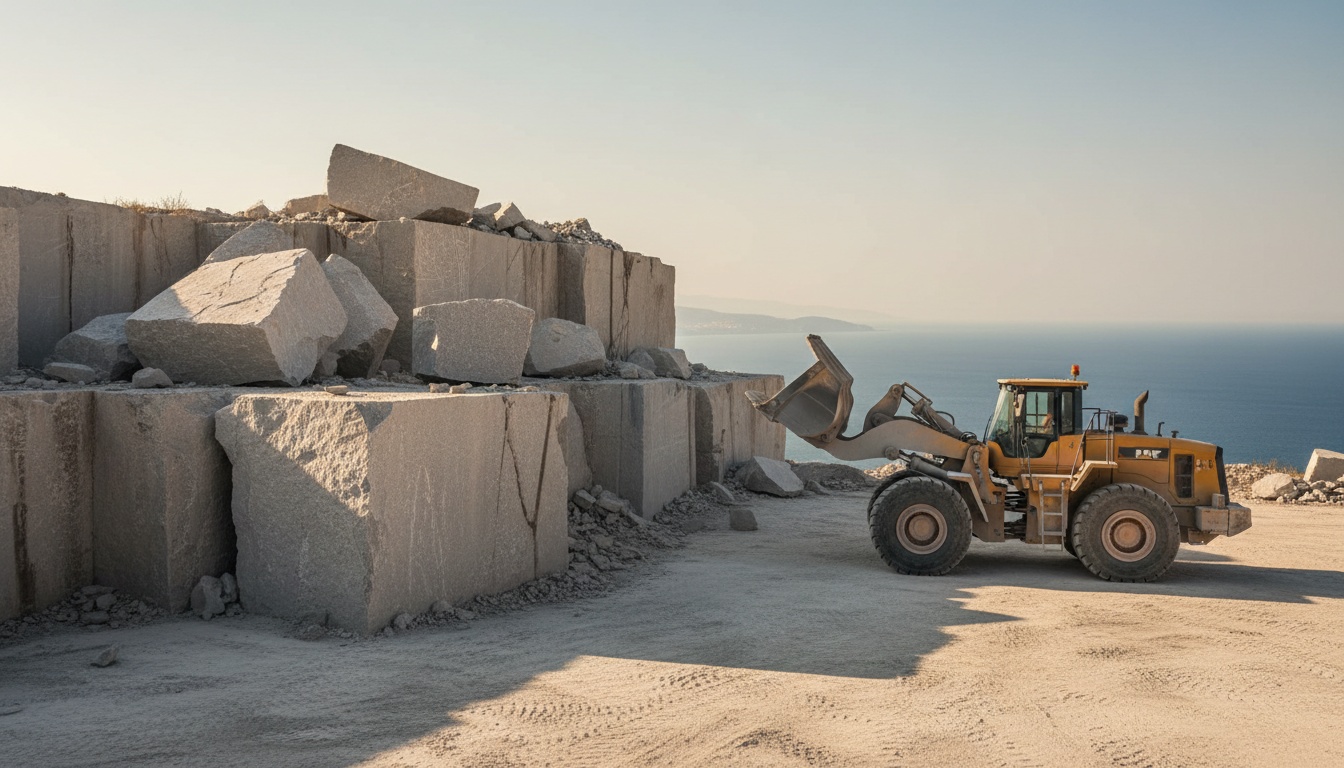
Armour rock under HS 2516.90 and 2517.10 is the heavy end of the quarry trade: rock blasted and sorted, not crushed, and bought by weight class rather than by sieve. A breakwater or revetment design (CIRIA Rock Manual, EN 13383) calls for a primary armour layer of, say, 3–6 t or 6–10 t, an underlayer of 300–1,000 kg or 1–3 t, a filter layer of 60–300 kg and a core of 1–500 kg quarry run, each with a specified weight distribution (W50, and limits on the fraction lighter and heavier than the class), and a contractor is paid on the tonnes placed in each layer. The stone has to be sound and dense. Granite, gabbro and basalt at ≥ 2.6–2.9 t/m³ give the mass per block the designer assumed; water absorption ≤ 1–2% and a magnesium sulphate soundness loss ≤ 12% (or freeze-thaw where the climate demands it) say the block will not split in service; LA abrasion ≤ 25–30% and a point-load or unconfined compressive strength above 100 MPa say it will survive handling, and blockiness and a length-to-thickness ratio under 3 keep the placement interlocking. Chloride and sulphate are checked when the rock sits against reinforced structures, and a visual check for open fissures and clay seams is done at the quarry face, not the discharge berth.
The freight is the deal. UN Comtrade, 2025 export declarations: Oman exported 12.02 million MT of HS 2517 at USD 6/MT FOB, Indonesia 9.20 million MT at USD 7, Malaysia 5.90 million MT at USD 9 and Canada 9.24 million MT at USD 17; under HS 2516 (granite and other monumental or building stone, which includes rough blocks as well as boulders) India declared 9.29 million MT at USD 60/MT and Brazil 0.82 million MT. Quarry-gate armour rock sits between those numbers, USD 8–25/MT depending on class and origin, and a Supramax voyage from Fujairah, Sohar, Andhra Pradesh or Tamil Nadu to the Maldives, Bangladesh or the Gulf costs more per tonne than the rock does, which is why we do not quote FOB alone. The stone is loaded by excavator, grab or wheel loader into Handysize and Supramax holds (boulders over 1 t need dunnage and a stowage plan the master will accept) or onto flat-top deck barges for short lanes and for discharge over a beach or an unfinished breakwater with no berth; deck barges also allow direct placement by excavator where the design permits. CBIL is a commodity brokerage company that also runs a chartering desk (LaycanDesk), and we price the rock with the vessel: Omani and Indian boulder stems into the Bay of Bengal and the Coast Connect enquiries we are working now are quoted CFR or CIF with the ship named, laytime matched to the quarry's loading rate and the discharge method agreed with the contractor. Send your weight classes and tonnes per layer, the design standard, the density and absorption limits, the discharge point and whether it has a berth, and we match quarry and tonnage against them.
Need the ship as well? Our chartering desk prices bulk limestone, gypsum and aggregates freight on LaycanDesk.
Indicative reference
$8–25 FOB; delivered set by freight USD / MT
as at September 2026
Reference level only — not an offer, and reviewed quarterly. Levels shown are as at September 2026. Firm pricing is quoted per RFQ, subject to volume, terms and inspection.
Typical Specification
Specifications are indicative and adjusted to the agreed contract and destination requirements. Final spec confirmed on COA / SGS.
Available Grades
Applications
- Breakwaters & harbour moles
- Revetments & seawalls
- Land reclamation & bund walls
- Coastal protection & beach groynes
- River training & scour protection
- Pipeline & cable rock berms
Category
Industrial Minerals & Construction
Incoterms
FOB · CFR · CIF
Pricing basis
USD / MT
Inspection
SGS / Intertek at load port
Armour Rock & Boulders — buyer questions
Why is armour rock quoted with the ship rather than FOB?
Because the rock is worth USD 6–25/MT at the quarry (UN Comtrade, 2025 export declarations put Omani HS 2517 at USD 6/MT and Malaysian at USD 9/MT) and a Supramax voyage from the Gulf of Oman or the Indian east coast to the Maldives, Bangladesh or the Gulf costs more than that per tonne. An FOB number tells you nothing about your delivered cost. We quote CFR or CIF with the vessel, laytime and discharge method fixed, so the contractor knows the landed price per tonne placed.
How is grading by weight verified?
At the quarry, by weighing a sample of blocks from each class on a calibrated loader scale or weighbridge and plotting the distribution against the EN 13383 or project envelope (W50, and the percentage lighter and heavier than the class limits). SGS or Intertek witness the sampling and issue the certificate with density, absorption and soundness results, so the engineer signs off before loading. Fragments and undersize generated by handling are controlled by a maximum fines allowance in the contract.
Vessel or deck barge?
A geared Handysize or Supramax carries 25,000–58,000 MT and suits a long lane into a port with a berth and a laydown area; blocks over 1 t need a stowage plan and the master's agreement. A flat-top deck barge carries 3,000–10,000 MT, works short lanes such as the Gulf, the Malacca Strait or the Bay of Bengal coast, and can discharge over a beach or directly onto the breakwater by excavator where there is no berth. We run both from the chartering desk and choose by lane, tonnes per layer and what is at the discharge end.
Which origins and rock types are available?
Gabbro from Fujairah in the UAE and from Omani quarries near Sohar and Shinas, granite from Andhra Pradesh and Tamil Nadu in India, and granite and basalt from Malaysia and Indonesia. All are ≥ 2.6 t/m³ and well below the absorption and abrasion limits in the CIRIA Rock Manual; the choice between them is nearly always the freight to your discharge point and the quarry's ability to sort and load the classes you need at the rate the ship needs.
Ready to source Armour Rock?
Send your quantity, specification, preferred Incoterms and destination port. We'll verify supply and respond with a workable offer — usually within one business day.
Have Armour Rock to sell? Submit an offer — we'll match it against live buyer demand.
More in Limestone, Gypsum & Aggregates
Limestone (Flux & Crushed)
High-CaCO₃ flux lumps and crushed stone in Supramax lots
Natural Gypsum Rock
Cement- and board-grade natural gypsum, 88–95% purity
Construction Aggregates (Gabbro, Granite & Armour Rock)
Gabbro, granite and armour rock in Supramax lots
Magnesite (Raw & Calcined Magnesia)
Raw magnesite lumps and dead-burned magnesia for refractories
Steel Slag, GBFS & Mill Scale
GBFS for cement grinders, steel slag and mill scale in Supramax lots