
Fluorspar (Acidspar ≥ 97% CaF₂ & Metspar)
Acidspar (CaF₂ ≥ 97%) for AHF, LiPF₆ & PVDF battery chemicals; Metspar for steel flux
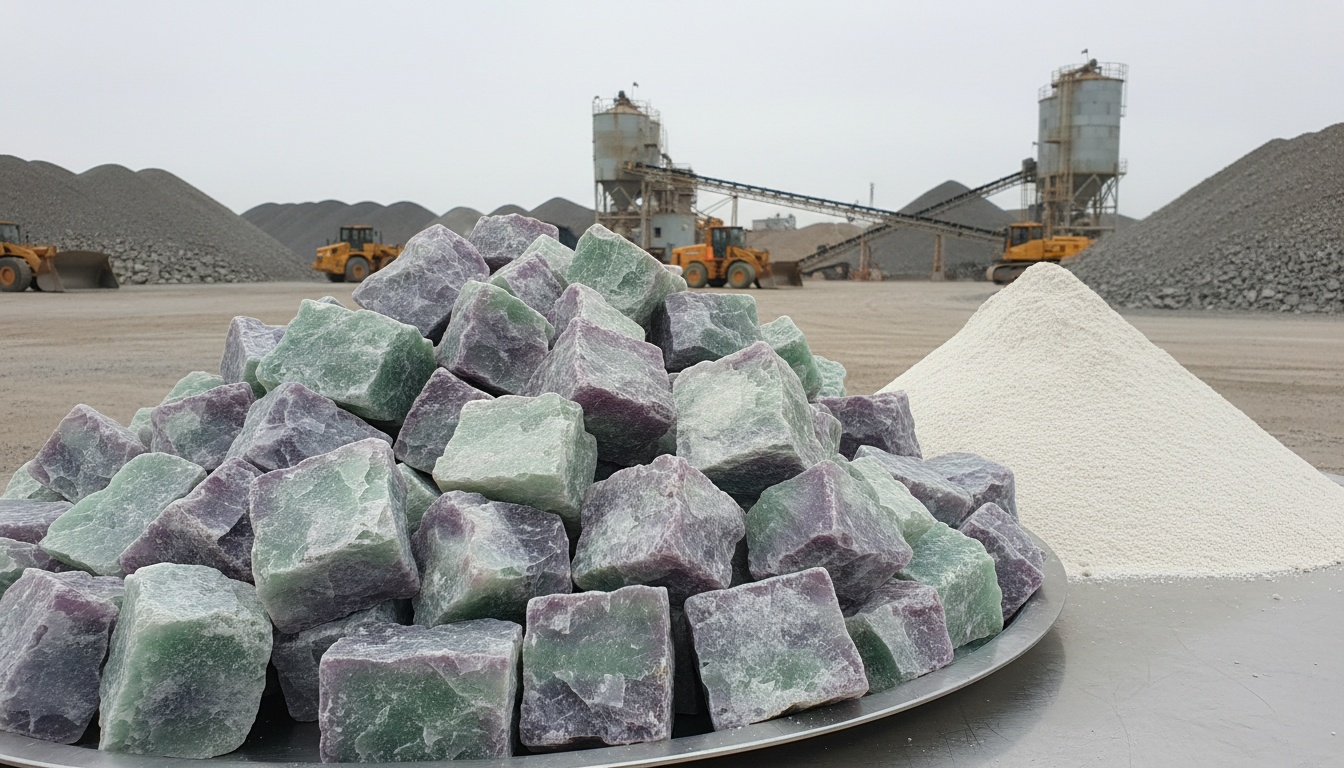
Fluorspar (calcium fluoride, CaF₂) is the foundational, non-substitutable source of fluorine for the global chemical, semiconductor, and clean energy sectors. The international trade splits sharply at 97% CaF₂ purity: Acid-Grade Fluorspar (Acidspar, HS 2529.22) is a refined flotation concentrate containing ≥ 97.0% CaF₂, functioning as the sole commercial precursor for Anhydrous Hydrofluoric Acid (AHF). Metallurgical-Grade Fluorspar (Metspar, HS 2529.21) assays at 75–85% CaF₂ as coarse gravel or briquettes, functioning as a slag fluidizer and dephosphorizing/desulphurizing flux in Basic Oxygen Furnace (BOF) and Electric Arc Furnace (EAF) steelmaking.
In chemical AHF synthesis (Buss-Luwa rotary kiln process at 200–300 °C: CaF₂ + H₂SO₄ → 2HF + CaSO₄), practical operating factors dictate that producing 1.0 MT of AHF requires 2.15 to 2.25 MT of dry acidspar and 1.30 MT of concentrated sulphuric acid (generating 3.6–3.8 MT of synthetic anhydrite screed byproduct). Impurities trigger destructive side reactions: every 1.0 MT of silica (SiO₂) destroys 1.33 MT of high-value HF gas by forming volatile silicon tetrafluoride (SiF₄) and fluorosilicic acid while releasing water that strips the protective iron-sulphate passivating layer from the carbon-steel kiln shell, inducing severe electrochemical corrosion. Calcite (CaCO₃) consumes expensive acid parasitically and triggers violent foaming and dust carryover, while arsenic (As) volatilizes into toxic AsF₃ that disqualifies AHF from semiconductor-grade electronic wet chemical lines (SEMI Grade 5 UP-HF).
The global fluorspar balance has undergone a structural inversion: China—historically supplying > 55–60% of world volume—has become a structural net importer (importing over 1.02 million MT of raw fluorspar in 2024 alone to feed its domestic battery and solar manufacturing). Chinese acidspar exports collapsed 77% from 235,684 MT in 2022 to 54,561 MT in 2024, and MOFCOM/GACC reinstated strict export licensing effective 1 January 2026. Concurrently, EV lithium-ion battery demand is exploding: LiPF₆ conducting salt contains 75.0% fluorine by weight (consuming 2.5–2.8 MT acidspar per MT of salt), and PVDF cathode binders and separator coatings consume 150–240 MT acidspar equivalent per GWh of cell production.
To mitigate supply concentration risks, CBIL structures acidspar procurement across tier-1 non-Chinese primary corridors: Mexico's Las Cuevas mine (Koura / Orbia, San Luis Potosí, 280 kt/yr acidspar) evacuated via CPKC rail to dedicated deepwater bulk terminals at the Port of Tampico; South Africa's Bushveld complex (Minersa's Vergenoeg mine, 240 kt/yr, and SepFluor's Nokeng mine, 180 kt/yr) exporting through the Port of Durban and Richards Bay; Spain's Minersa Asturias operations; and Viet Nam's Masan High-Tech Materials Nui Phao polymetallic complex via Port Haiphong. Ocean shipments of acidspar filter cake (8.0%–10.5% moisture) are classified under the IMO IMSBC Code as Group A Cargoes that may liquefy if shipped above their Transportable Moisture Limit (TML); all seaborne parcels carry certified Flow Moisture Point (FMP) and moisture tests completed within 7 days of loading. Parcels move in 15,000–30,000 MT Handysize bulk carriers or in 1,000 kg FIBC bags in 20ft dry containers.
Need the ship as well? Our chartering desk prices bulk limestone, gypsum and aggregates freight on LaycanDesk.
Excluded origins are not offered, including product re-exported, blended or re-processed through a third country. Every lot moves with a certificate of origin naming the producing plant, mine or grower country, and nothing is quoted before the seller and loading point are known.
Indicative reference
$480–$560 (Acidspar dry MT FOB) / $320–$390 (Metspar FOB) USD / MT
as at September 2026
Reference level only — not an offer, and reviewed quarterly. Levels shown are as at September 2026. Firm pricing is quoted per RFQ, subject to volume, terms and inspection.
Typical Specification
Specifications are indicative and adjusted to the agreed contract and destination requirements. Final spec confirmed on COA / SGS.
Available Grades
Applications
- Anhydrous Hydrofluoric Acid (AHF) synthesis (rotary kilns)
- Lithium-ion battery electrolyte salts (LiPF₆, LiFSI)
- PVDF fluoropolymer cathode binders & separator coatings
- Semiconductor wet chemical etching (SEMI Grade 5 UP-HF)
- Next-generation ultra-low GWP refrigerants (HFO-1234yf / ze)
- Steelmaking & foundry ladle fluxing (metspar gravel)
- Primary aluminium smelting (AlF₃ / synthetic cryolite)
Category
Industrial Minerals & Construction
Incoterms
FOB · CFR · CIF
Pricing basis
USD / MT
Inspection
SGS / Intertek at load port
Fluorspar (Acidspar ≥ 97% CaF₂ & Metspar) — buyer questions
Why is silica (SiO₂) capped so strictly in acid-grade fluorspar?
Silica reacts with newly liberated hydrofluoric acid gas in the rotary kiln (SiO₂ + 4HF → SiF₄ + 2H₂O). Every 1.0 MT of silica consumes 1.33 MT of high-value HF gas, converting it into low-value fluorosilicic acid. Furthermore, the generated water dilutes hot sulphuric acid inside the kiln, stripping the protective iron-sulphate passivating coating and causing severe corrosion of the carbon steel kiln shell.
How has the EV battery transition reshaped global fluorspar demand?
Lithium-ion battery manufacturing is the fastest-growing fluorine consumption vector. The primary conducting salt, LiPF₆, contains 75.0% elemental fluorine by weight, requiring 2.5–2.8 MT of high-purity acidspar per MT of salt. Additionally, battery-grade PVDF used as a cathode binder (NMC/LFP) and separator thermal coating requires 150–240 MT of acidspar equivalent per GWh, driving demand independent of traditional steel and refrigerant cycles.
Why has China transitioned from a dominant exporter to a net importer of fluorspar?
Decades of intensive mining depleted China's shallow, high-grade deposits, dropping average run-of-mine grades from > 55% to 30–40% CaF₂. Aggressive environmental and mine safety crackdowns shuttered artisanal mines, while domestic AHF capacity exceeded 4.1 million MT/year to feed internal battery and solar gigafactories. As a result, China imported over 1.02 million MT of raw fluorspar in 2024 and re-instituted export licensing on 1 January 2026.
What safety protocols govern the ocean transport of acidspar filter cake?
Acidspar flotation filter cake (typically 8.0%–10.5% moisture) is classified under the IMO IMSBC Code as a Group A Cargo capable of liquefying if moisture exceeds the Transportable Moisture Limit (TML). Shippers must provide independent certification of Flow Moisture Point (FMP) and moisture testing performed within 7 days of loading. Vessels must be equipped with certified bilge systems, and loading is stopped during rainfall.
Ready to source Fluorspar?
Send your quantity, specification, preferred Incoterms and destination port. Qualified requirements receive a workable offer against verified supply.
Have Fluorspar to sell? Submit an offer — we'll match it against live buyer demand.
More in Limestone, Gypsum, Aggregates, Fluorspar & Refractory Minerals
Limestone (Flux & Crushed)
High-CaCO₃ flux lumps and crushed stone in Supramax lots
Natural Gypsum Rock
Cement- and board-grade natural gypsum, 88–95% purity
Construction Aggregates (Gabbro, Granite & Armour Rock)
Gabbro, granite and armour rock in Supramax lots
Magnesite (Raw & Calcined Magnesia)
Raw magnesite lumps and dead-burned magnesia for refractories
Steel Slag & Mill Scale
BOF and EAF steel slag and mill scale in Handymax and Supramax lots
Armour Rock & Boulders
Graded armour rock and boulders for breakwaters, in Supramax lots and on deck barges
Refractory Raw Materials (Calcined Bauxite, Fused Alumina, DBM)
Calcined bauxite, brown fused alumina and dead-burned magnesia by Al₂O₃, MgO, iron and density
Quicklime (Calcium Oxide, Burnt Lime)
High-calcium burnt lime by CaO, reactivity and size: lump, pebble and powder
Hydrated Lime (Calcium Hydroxide, Slaked Lime)
Calcium hydroxide powder by Ca(OH)₂ and fineness: building, water and food grade E526
Dolomitic Lime & Burnt Dolomite (Doloma)
Calcined dolomite by MgO and CaO for steel slag conditioning and refractories
Silica Fume / Microsilica (Densified & Undensified)
Densified and undensified microsilica at 85–96% SiO₂ for high-performance concrete and refractories
Refractory Castables & Mortars (Dense, Insulating, LCC / ULCC)
Dense and insulating castables, low- and ultra-low-cement grades, gunning mixes and air-setting mortars by alumina content and service temperature
Granite Blocks (Crude & Rough-Trimmed Dimension Stone)
Quarry blocks by colour, size class and soundness for slab processors in China, Italy and the Middle East
Raw Dolomite (Flux, Glass & Refractory Grade)
Uncalcined dolomite by MgO, CaO, silica and size for blast furnaces, steel shops, glass and refractories