
Natural Gypsum Rock
Cement- and board-grade natural gypsum, 88–95% purity
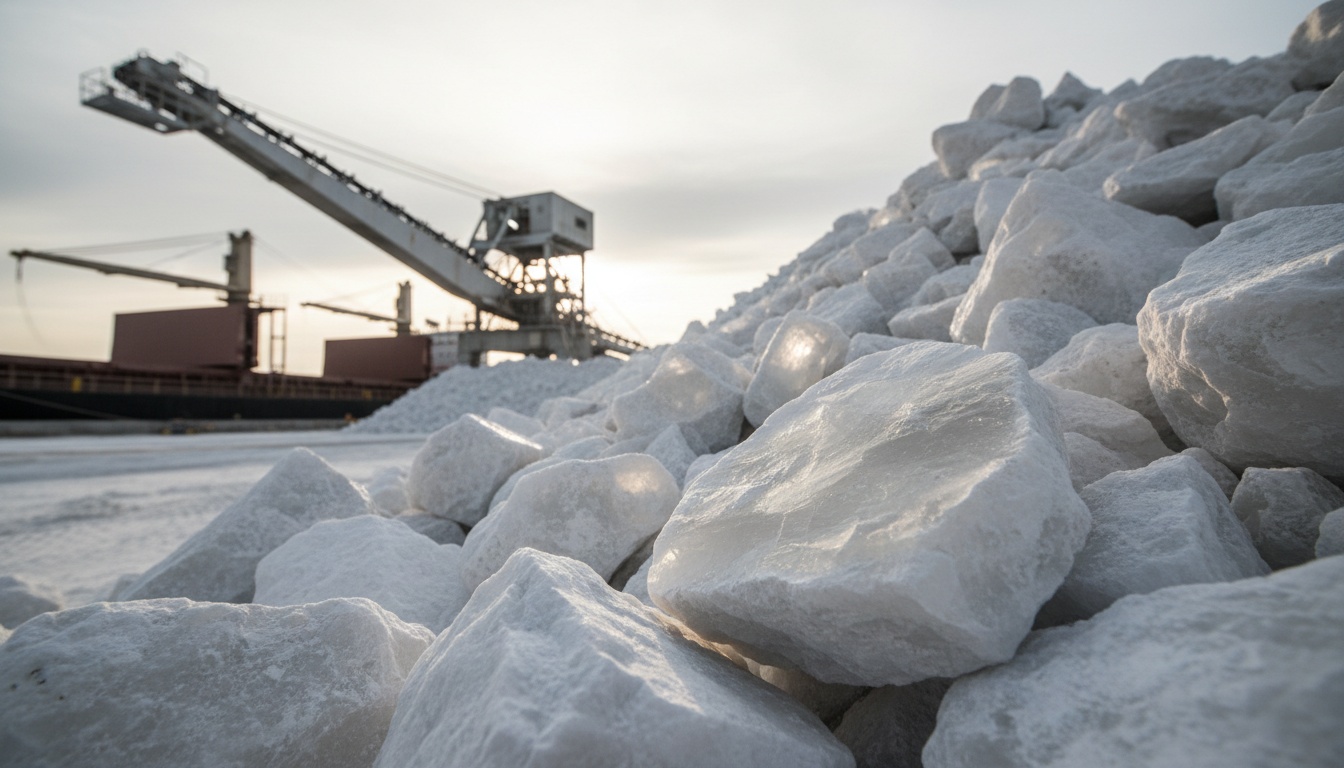
Natural gypsum under HS 2520.10 is calcium sulphate dihydrate, and the specification that matters is how much of the rock actually is that mineral. Cement-grade material is contracted at 85–92% CaSO₄·2H₂O, plasterboard and plaster grades at 92–95%, and the difference between them is not academic: a cement mill adds 3–5% gypsum to clinker to control setting time, so a few points of purity change the dose and the SO₃ balance in the finished cement, whereas a board plant calcines the rock to hemihydrate and any clay, carbonate or anhydrite in it comes through as weaker board or slower calcining. Anhydrite (CaSO₄) content is watched separately because it does not release water on calcining; chlorides are capped at ≤ 0.02–0.05% because they corrode steel in concrete and stain board; combined SiO₂, Al₂O₃ and Fe₂O₃ are held under 3–5%. Moisture ≤ 3–5% and a 0–50 mm size band suit a cement mill feed; board plants may take run-of-mine up to 200 mm and crush on site. Whiteness matters for plaster, less so for cement.
Oman is the market. UN Comtrade, 2025 export declarations: Oman shipped 14.32 million MT of HS 2520 at USD 14/MT FOB, Thailand 5.65 million MT at USD 29, Morocco 2.16 million MT at USD 18, Canada 2.19 million MT at USD 20. Oman's own 2025 declarations send 6.92 million MT (48%) to India, 1.89 million MT to Vietnam, 1.47 million MT to Bangladesh, 1.10 million MT to Indonesia, 593k MT to Kenya and 513k MT to Japan, almost all at USD 13–14/MT. That is a Salalah-loading trade in Supramax lots where the cargo on board is worth USD 700,000–800,000 and the freight to Southeast Asia or East Africa is comparable, so the vessel is half the deal. Board makers and larger cement groups run self-unloaders or gearless Supramaxes on term; spot buyers take geared tonnage into ports without shore cranes. CBIL is a commodity brokerage company with a chartering desk (LaycanDesk), so the cargo and the ship are worked together, on FOB, CFR and CIF terms, against SGS purity, chloride and sizing certification. Send your purity floor, chloride limit, size band and whether your berth has cranes, and we place the tonnage accordingly.
Need the ship as well? Our chartering desk prices bulk limestone, gypsum and aggregates freight on LaycanDesk.
Indicative reference
$12–30 USD / MT
as at September 2026
Reference level only — not an offer, and reviewed quarterly. Levels shown are as at September 2026. Firm pricing is quoted per RFQ, subject to volume, terms and inspection.
Typical Specification
Specifications are indicative and adjusted to the agreed contract and destination requirements. Final spec confirmed on COA / SGS.
Available Grades
Applications
- Cement set retarder (3–5% addition)
- Plasterboard & wallboard
- Plaster of Paris & stucco
- Agricultural soil conditioner
- Glass & ceramics
Category
Industrial Minerals & Construction
Incoterms
FOB · CFR · CIF
Pricing basis
USD / MT
Inspection
SGS / Intertek at load port
Natural Gypsum Rock — buyer questions
What purity should a cement plant specify against a board plant?
Cement plants normally buy 85–92% CaSO₄·2H₂O because the gypsum is a 3–5% additive and the mill can adjust the dose. Board plants need 92–95% because they calcine the whole rock and every impurity ends up in the board. If you are a cement buyer paying for a 95% spec you are paying for purity you do not use; if you are a board buyer accepting 88% you will see it in calcining rate and board strength.
Why is chloride capped so low?
Chlorides in cement attack reinforcing steel, and in plasterboard they migrate to the paper face and cause staining and delamination. Most contracts cap Cl⁻ at 0.02–0.05%. Coastal or salt-affected deposits and cargoes wetted with seawater during loading are the usual sources of a failed chloride test, so we specify covered stockpiles and a load-port analysis.
Where does Omani gypsum actually go?
By Oman's own 2025 export declarations (UN Comtrade): India 6.92 million MT, Vietnam 1.89 million MT, Bangladesh 1.47 million MT, Indonesia 1.10 million MT, Kenya 593k MT, Japan 513k MT, at USD 13–14/MT FOB. If you are buying into any of those lanes there is established tonnage and established terms to benchmark against.
Do I need a self-unloader?
Only if your berth has no cranes and no shore hopper, or if discharge speed is the binding constraint on a term contract. Most spot cargoes move on geared Supramaxes into ports with limited infrastructure and on gearless tonnage into equipped cement terminals. Tell us the berth and we match the ship; that is the point of running a chartering desk alongside the cargo book.
Ready to source Gypsum?
Send your quantity, specification, preferred Incoterms and destination port. We'll verify supply and respond with a workable offer — usually within one business day.
Have Gypsum to sell? Submit an offer — we'll match it against live buyer demand.
More in Limestone, Gypsum & Aggregates
Limestone (Flux & Crushed)
High-CaCO₃ flux lumps and crushed stone in Supramax lots
Construction Aggregates (Gabbro, Granite & Armour Rock)
Gabbro, granite and armour rock in Supramax lots
Magnesite (Raw & Calcined Magnesia)
Raw magnesite lumps and dead-burned magnesia for refractories
Steel Slag, GBFS & Mill Scale
GBFS for cement grinders, steel slag and mill scale in Supramax lots
Armour Rock & Boulders
Graded armour rock and boulders for breakwaters, in Supramax lots and on deck barges