
Steel Slag, GBFS & Mill Scale
GBFS for cement grinders, steel slag and mill scale in Supramax lots
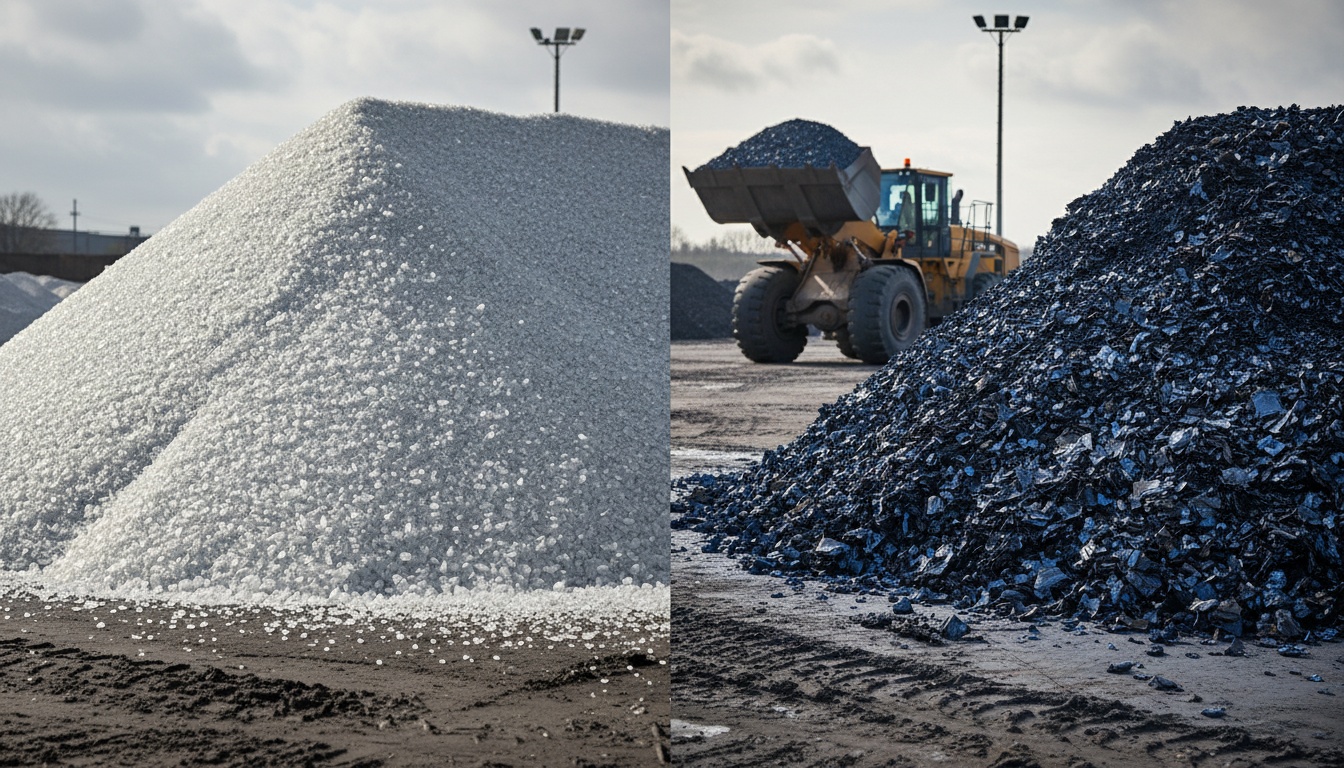
Three steelworks by-products move in bulk under HS 2618.00 and 2619.00, and each is bought on a different number. Granulated blast furnace slag (HS 2618.00) is molten iron-furnace slag quenched in water into a glassy sand; the buyer is a cement grinder, and the number that matters is glass content (≥ 95% by microscopy or XRD), because only the glassy fraction reacts with lime in cement. Chemistry sets its grade: (CaO + MgO)/SiO₂ ≥ 1.0 and (CaO + MgO + Al₂O₃)/SiO₂ ≥ 1.6–1.9 to EN 15167 and BS 6699, with Al₂O₃ around 12–16%, MgO ≤ 12–14%, sulphide sulphur ≤ 2%, chloride ≤ 0.1% and loss on ignition ≤ 3%. As delivered it is 0–5 mm sand at 8–15% moisture; once ground to a Blaine of 4,000–4,500 cm²/g it is GGBS with a 7-day activity index of ≥ 45–55% and 28-day of ≥ 70–95% against reference cement. Steel slag (HS 2619.00, from BOF and EAF converters) is denser and does not vitrify, so it goes to road aggregate, railway ballast and cement raw feed rather than cement replacement; its risk is free lime (≤ 3–5% after weathering), which hydrates and expands, and free MgO, so it is sold aged and tested for volume stability. Mill scale (also HS 2619.00) is the dark flaky iron oxide (Fe₃O₄, FeO, Fe₂O₃) knocked off hot-rolled steel, 68–72% Fe with oil ≤ 0.5–1% and SiO₂, Al₂O₃ and P held low, and it is bought by sinter plants and cement kilns as an iron unit. Under the IMSBC Code mill scale ships as a Group A cargo when it is fine and wet, that is when a significant share is below 7 mm and moisture is near the transportable moisture limit, so a flow-moisture and TML certificate within six months and a moisture test within seven days of loading are required before a ship will take it; coarse, dry material can be declared Group C.
Japan is the reference exporter of GBFS to Asia. UN Comtrade, 2025 export declarations: Japan shipped 10.65 million MT of HS 2618 to 28 partners, led by Other Asia, nes (2.86 million MT, 26.8%, USD 8/MT), the USA (2.30 million MT at USD 12), Australia (1.46 million MT at USD 6), Malaysia (544k MT at USD 1), the United Kingdom (495k MT at USD 19), Singapore (331k MT at USD 11), Viet Nam (255k MT at USD 3), the UAE (234k MT at USD 3) and Qatar (116k MT at USD 2). China's own 2025 export declarations for HS 2619 are not available on UN Comtrade, so we do not quote a figure for them. Those unit values say what the trade is: the slag is worth USD 1–12/MT on the quay and the ship is the cost, so a Bangladeshi, West African or Gulf cement grinder buying GBFS is really buying a Supramax voyage with a slag cargo in it. The same holds for steel slag out of Chinese ports into the Bay of Bengal and for mill scale moving from Bangladeshi and Indian rolling mills to Vietnamese and Chinese sinter plants; steel-slag and mill-scale stems on those lanes are on our chartering desk now. CBIL is a commodity brokerage company with a chartering desk (LaycanDesk), so we quote cargo and vessel together, on FOB, CFR and CIF terms, against SGS, Intertek or Bureau Veritas certificates for glass content, chemistry, moisture and (for mill scale) Fe, oil and TML. Send your activity-index or Fe requirement, moisture ceiling, discharge port and whether you have a hopper or need geared tonnage, and we work the source and the ship to it.
Need the ship as well? Our chartering desk prices bulk limestone, gypsum and aggregates freight on LaycanDesk.
Indicative reference
$1–20 slag; $80–150 mill scale USD / MT
as at September 2026
Reference level only — not an offer, and reviewed quarterly. Levels shown are as at September 2026. Firm pricing is quoted per RFQ, subject to volume, terms and inspection.
Typical Specification
Specifications are indicative and adjusted to the agreed contract and destination requirements. Final spec confirmed on COA / SGS.
Available Grades
Applications
- Slag cement & GGBS cement replacement
- Cement raw feed (steel slag, mill scale as iron corrective)
- Sinter plant iron units (mill scale)
- Road base, asphalt & railway ballast (steel slag)
- Ferro-alloy & briquetting feed
- Marine fill & reclamation (steel slag)
Category
Industrial Minerals & Construction
Incoterms
FOB · CFR · CIF
Pricing basis
USD / MT
Inspection
SGS / Intertek at load port
Steel Slag, GBFS & Mill Scale — buyer questions
What is the difference between GBFS and steel slag, and which do I want?
GBFS is iron blast-furnace slag quenched into glass; ground to 4,000–4,500 Blaine it replaces 30–70% of the clinker in cement, which is why cement grinders in Bangladesh, West Africa and the Gulf buy it. Steel slag from a BOF or EAF is crystalline, does not react the same way and carries free lime that swells, so it goes to aggregate, ballast, fill and cement raw feed. If you are a cement grinder you want GBFS with a certified glass content; if you are a road or reclamation contractor you want weathered steel slag with a volume-stability test.
How is GBFS quality proven before the ship sails?
By a load-port certificate covering glass content (≥ 95%), the basicity ratios ((CaO + MgO)/SiO₂ ≥ 1.0, (CaO + MgO + Al₂O₃)/SiO₂ ≥ 1.6–1.9), MgO, sulphide sulphur, chloride, loss on ignition and moisture, and where the buyer asks for it, a ground sample tested for activity index at 7 and 28 days. Japanese producers publish this per shipment; for other origins we have SGS or Intertek draw the sample at the stockpile.
Why does mill scale need a TML certificate?
Because under the IMSBC Code mill scale is a Group A cargo, one that can liquefy, when a significant fraction is under 7 mm and it is wet. The shipper must present a transportable moisture limit certificate less than six months old and a moisture test taken within seven days of loading, with the actual moisture below the TML. Coarse, dry, well-drained mill scale can be declared Group C. A master will not load without the paperwork, so we arrange the sampling before the ship is fixed, not after.
What does the Japanese export data say about price and lanes?
UN Comtrade, 2025 export declarations: Japan exported 10.65 million MT of HS 2618, at USD 1/MT to Malaysia, USD 2–3/MT to Qatar, the UAE and Viet Nam, USD 6/MT to Australia, USD 8/MT to Other Asia, nes, USD 12/MT to the USA and USD 19/MT to the United Kingdom. Those are quay values; delivered cost into Chittagong, Tema or Jebel Ali is the freight. For steel slag and mill scale China's own HS 2619 declarations are not available on UN Comtrade for 2025, so we price those against firm quotes rather than published averages.
Ready to source Slag & Mill Scale?
Send your quantity, specification, preferred Incoterms and destination port. We'll verify supply and respond with a workable offer — usually within one business day.
Have Slag & Mill Scale to sell? Submit an offer — we'll match it against live buyer demand.
More in Limestone, Gypsum & Aggregates
Limestone (Flux & Crushed)
High-CaCO₃ flux lumps and crushed stone in Supramax lots
Natural Gypsum Rock
Cement- and board-grade natural gypsum, 88–95% purity
Construction Aggregates (Gabbro, Granite & Armour Rock)
Gabbro, granite and armour rock in Supramax lots
Magnesite (Raw & Calcined Magnesia)
Raw magnesite lumps and dead-burned magnesia for refractories
Armour Rock & Boulders
Graded armour rock and boulders for breakwaters, in Supramax lots and on deck barges