
Refractory Castables & Mortars (Dense, Insulating, LCC / ULCC)
Dense and insulating castables, low- and ultra-low-cement grades, gunning mixes and air-setting mortars by alumina content and service temperature
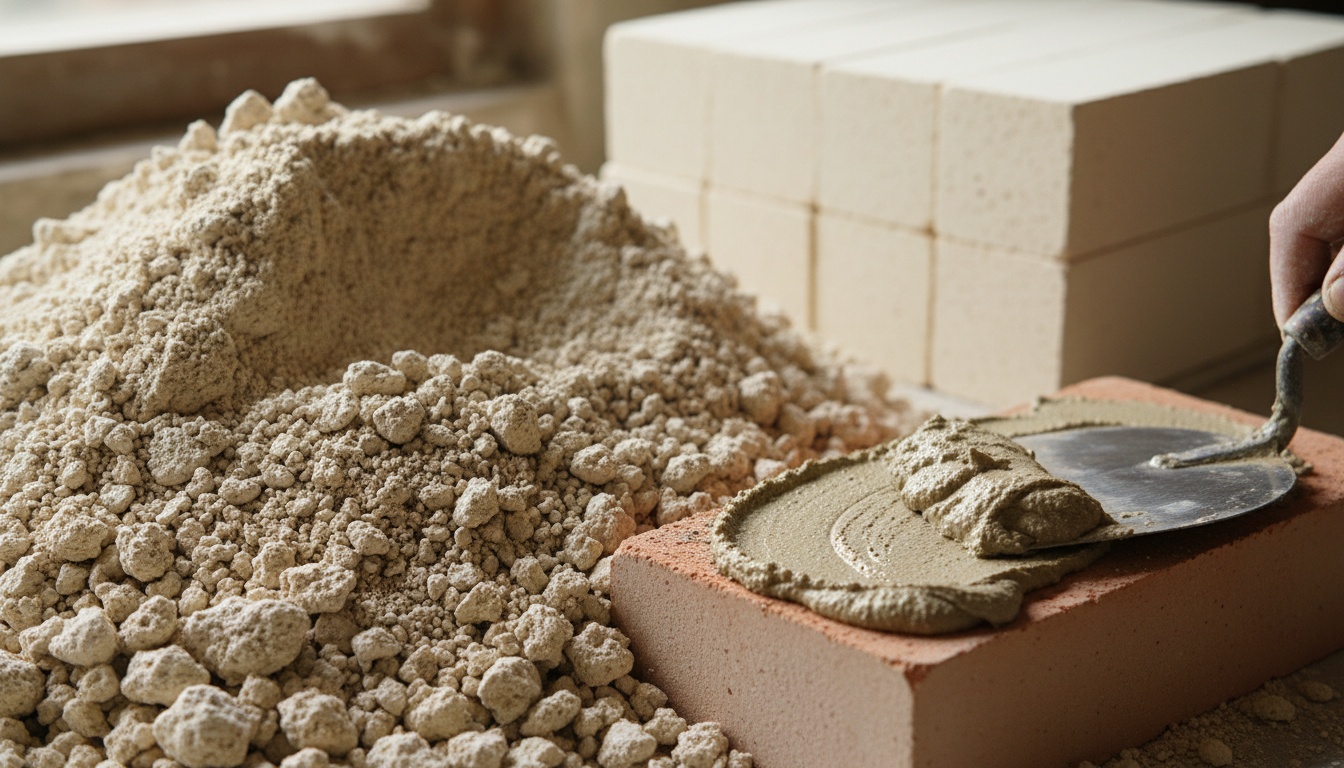
A castable is a graded refractory aggregate (fireclay, bauxite, andalusite, tabular or fused alumina, mullite, spinel) bonded with calcium aluminate cement and fine reactive fillers such as microsilica and calcined alumina, delivered dry and placed with water by vibration, pumping or gunning. The classification the trade uses is by lime content from the cement. ASTM C401 classes alumina and alumina-silicate castables with bulk density above 1.68 g/cm³ by CaO: conventional castables carry roughly 15–25% cement, low-cement castables (LCC) about 1.0–2.5% CaO, ultra-low-cement (ULCC) 0.2–1.0% CaO, and no-cement castables below that, with medium-cement (MCC) sitting between conventional and LCC. EN ISO 1927-1 is the European classification of unshaped refractories covering castables, gunning, ramming and plastic materials and jointing mortars. Less cement means less water, higher hot strength and better slag and thermal-shock resistance, at the cost of a narrower water window and stricter mixing and curing discipline on site. Insulating castables are specified on bulk density and thermal conductivity rather than strength. The buyer also names Al₂O₃ content, maximum service temperature, cold crushing strength and modulus of rupture after drying and after firing, permanent linear change, and, for gunning mixes, rebound. Refractory mortars are air-setting or heat-setting jointing compounds matched to the brick they bond and are traded under the same heading.
Customs heading 3816 covers refractory cements, mortars, concretes and similar compositions other than the carbon-based preparations of 3801. The producers are the refractory houses of China, India, Türkiye and Germany, several of which run plants on more than one continent; buyers are cement plants relining kiln hoods, coolers and preheater cyclones, steel mills for ladle and tundish linings, aluminium smelters and casthouses, petrochemical and refinery furnaces, incinerators and boilers, and the installation contractors who work for them. CBIL is a commodity brokerage company and brokers castables, gunning mixes and mortars from those producers to end users and contractors against the manufacturer's technical data sheet and batch certificate (chemistry, bulk density, CCS and MOR at stated temperatures, PLC, water addition and setting time), a safety data sheet, and a certificate of origin, packed in 25 kg moisture-barrier bags on shrink-wrapped pallets or 1 MT jumbo bags in 20-ft containers, on FOB, CFR and CIF terms. Shelf life is limited to the period on the maker's sheet, so production date and dry storage are written into the order. Raw materials for refractories (bauxite, magnesia, andalusite, fused alumina) have their own page; Chinese magnesia-based products should be checked against the current export licence catalogue. Price is agreed per MT on grade and pack. Send the application (kiln zone, ladle, furnace), service temperature, Al₂O₃ and density class, the placement method and monthly or project tonnage and the enquiry is screened and worked against it.
Need the ship as well? Our chartering desk prices bulk limestone, gypsum and aggregates freight on LaycanDesk.
Excluded origins are not offered, including product re-exported, blended or re-processed through a third country. Every lot moves with a certificate of origin naming the producing plant, mine or grower country, and nothing is quoted before the seller and loading point are known.
Indicative reference
Per MT, on grade and pack USD / MT
as at September 2026
Reference level only — not an offer, and reviewed quarterly. Levels shown are as at September 2026. Firm pricing is quoted per RFQ, subject to volume, terms and inspection.
Typical Specification
Specifications are indicative and adjusted to the agreed contract and destination requirements. Final spec confirmed on COA / SGS.
Available Grades
Applications
- Cement kiln hoods, coolers & preheaters
- Steel ladle, tundish & EAF delta linings
- Aluminium furnaces & casthouses
- Petrochemical & refinery heaters
- Incinerators & power boilers
- Brick jointing & repair
Category
Industrial Minerals & Construction
Incoterms
FOB · CFR · CIF
Pricing basis
USD / MT
Inspection
SGS / Intertek at load port
Refractory Castables & Mortars (Dense, Insulating, LCC / ULCC) — buyer questions
What is the difference between conventional, low-cement and ultra-low-cement castables?
The lime from the calcium aluminate cement. Conventional castables carry roughly 15–25% cement; low-cement castables run about 1.0–2.5% CaO and ultra-low-cement 0.2–1.0% CaO, with microsilica and reactive alumina taking over the bond. Less cement means less mixing water, higher hot strength and better slag and thermal-shock resistance, but a narrower water window and stricter mixing, curing and dry-out on site.
Which numbers do I need on the data sheet?
Al₂O₃ and the rest of the chemistry, maximum service temperature, bulk density, cold crushing strength and modulus of rupture after 110 °C drying and after firing at the stated temperatures, permanent linear change, water addition and working time. For insulating grades, density and thermal conductivity matter more than strength; for gunning mixes, rebound.
How long can a castable be stored?
Shelf life is set by the manufacturer and counted from the production date in dry storage, because the cement hydrates from atmospheric moisture. We write the production date and moisture-barrier packing into the order and ship against a current batch certificate.
Do you supply the raw materials as well?
Bauxite, fused and tabular alumina, andalusite, magnesia and other refractory raw materials are brokered separately and have their own page. This page covers the finished monolithics: castables, gunning and ramming mixes and mortars under HS 3816.
Ready to source Refractory Castables?
Send your quantity, specification, preferred Incoterms and destination port. Qualified requirements receive a workable offer against verified supply.
Have Refractory Castables to sell? Submit an offer — we'll match it against live buyer demand.
More in Limestone, Gypsum, Aggregates, Fluorspar & Refractory Minerals
Limestone (Flux & Crushed)
High-CaCO₃ flux lumps and crushed stone in Supramax lots
Natural Gypsum Rock
Cement- and board-grade natural gypsum, 88–95% purity
Construction Aggregates (Gabbro, Granite & Armour Rock)
Gabbro, granite and armour rock in Supramax lots
Magnesite (Raw & Calcined Magnesia)
Raw magnesite lumps and dead-burned magnesia for refractories
Steel Slag, GBFS & Mill Scale
GBFS for cement grinders, steel slag and mill scale in Supramax lots
Armour Rock & Boulders
Graded armour rock and boulders for breakwaters, in Supramax lots and on deck barges
Fluorspar (Acidspar ≥ 97% CaF₂ & Metspar)
Acidspar (CaF₂ ≥ 97%) for AHF, LiPF₆ & PVDF battery chemicals; Metspar for steel flux
Refractory Raw Materials (Calcined Bauxite, Fused Alumina, DBM)
Calcined bauxite, brown fused alumina and dead-burned magnesia by Al₂O₃, MgO, iron and density
Quicklime (Calcium Oxide, Burnt Lime)
High-calcium burnt lime by CaO, reactivity and size: lump, pebble and powder
Hydrated Lime (Calcium Hydroxide, Slaked Lime)
Calcium hydroxide powder by Ca(OH)₂ and fineness: building, water and food grade E526
Dolomitic Lime & Burnt Dolomite (Doloma)
Calcined dolomite by MgO and CaO for steel slag conditioning and refractories
Silica Fume / Microsilica (Densified & Undensified)
Densified and undensified microsilica at 85–96% SiO₂ for high-performance concrete and refractories
Granite Blocks (Crude & Rough-Trimmed Dimension Stone)
Quarry blocks by colour, size class and soundness for slab processors in China, Italy and the Middle East