
Boron Fertilizers: Borax, Boric Acid, Granular Boron 15% & Disodium Octaborate
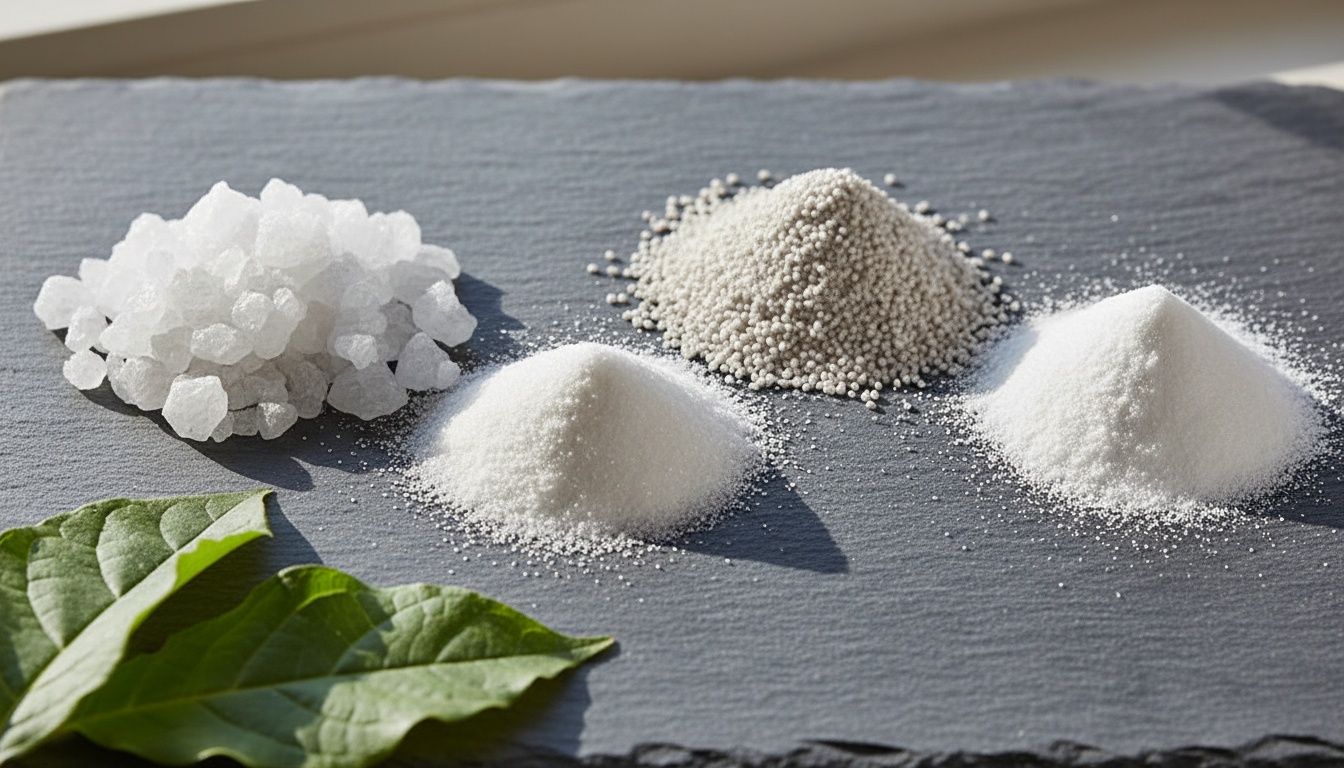
Borax deca/pentahydrate, boric acid, granular boron 15% B and 20.8% B octaborate | Türkiye and US origins
Boron is sold by its boron content and by how it dissolves. Borax decahydrate (Na₂B₄O₇·10H₂O) carries 11.3% B, borax pentahydrate about 15% B, boric acid (H₃BO₃) 16.5% B, and disodium octaborate tetrahydrate 20.5–20.8% B (67% B₂O₃), the fast-dissolving grade made by reacting borax with boric acid and sold for foliar and fertigation programmes. Granular boron 15% B is borax pentahydrate screened to about 2.8 mm (SGN 280, −4/+14 mesh) with no coating or filler, made for bulk blenders so the boron granule travels with the NPK rather than segregating in the bag or the spreader. Typical applications are about 1.1 kg of actual boron per hectare, so a tonne of 15% B granular treats roughly 135 hectares; the margin between deficiency and toxicity is narrow, which is why the blender wants an assayed, uniform granule rather than a mixed powder. In oil palm, boron is described by the potash producers as the most important micronutrient, needed for root development, cell wall formation, pollination and fruit development; oilseeds, legumes and cotton are the other crops most often written into boron programmes.
Supply is concentrated. Türkiye holds about 73% of the world's known borate deposits and the state producer Eti Maden held about 47% of global borate production in 2012, with plants at Bandırma (boric acid, octaborate), Kırka, Emet and Bigadiç; the US industry works the California deposits, and Chile, Peru, Argentina and Bolivia produce boric acid from Andean salars. Trade data show the split: 2023 exports of borates (HS 2840) were about USD 716 million, led by the United States (62%), the Netherlands (7.4%, re-export), China (5.0%) and Türkiye (4.4%), while 2024 UN Comtrade reporting of boric acid (HS 2810) was led by the United States (48.1%), Chile (19.8%), Peru (6.5%), the Netherlands (4.4%) and Argentina (4.4%). CBIL brokers boron fertilizers against an SGS, Intertek or Bureau Veritas certificate of analysis for B or B₂O₃ content, particle size and heavy metals, with the certificate of origin, in 25 kg bags palletised in containers and 1,000 kg jumbo bags. Prices are negotiated per MT on grade and pack.
Need the ship as well? Our chartering desk prices bagged fertilizer freight on LaycanDesk.
Excluded origins are not offered, including product re-exported, blended or re-processed through a third country. Every lot moves with a certificate of origin naming the producing plant, mine or grower country, and nothing is quoted before the seller and loading point are known.
Indicative reference
Per MT, on grade and pack USD / MT
as at September 2026
Reference level only — not an offer, and reviewed quarterly. Levels shown are as at September 2026. Firm pricing is quoted per RFQ, subject to volume, terms and inspection.
Typical Specification
Specifications are indicative and adjusted to the agreed contract and destination requirements. Final spec confirmed on COA / SGS.
Available Grades
Applications
- Oil palm boron programmes (pollination, fruit set)
- Cotton, oilseed rape, sunflower and legume crops
- Granular boron in NPK bulk blends
- Foliar and fertigation solutions (octaborate, boric acid)
- Micronutrient premix and coating formulations
Category
Agriculture & Fertilizers
Incoterms
FOB · CFR · CIF · CPT
Pricing basis
USD / MT
Inspection
SGS / Intertek at load port
Boron Fertilizers: Borax, Boric Acid, Granular Boron 15% & Disodium Octaborate — buyer questions
Which boron grade goes in a bulk blend?
Granular boron 15% B, a borax pentahydrate granule of about 2.8 mm (SGN 280) with no filler or coating, sized to travel with NPK granules without segregating. Powdered borax or boric acid in a blend settles out and gives hot spots; the toxicity margin in boron is narrow, so uniform distribution is the point.
Boric acid or octaborate for foliar use?
Disodium octaborate tetrahydrate carries 20.5–20.8% B and dissolves fast, which is why it is the standard foliar and fertigation grade. Boric acid (16.5% B) is also soluble and cheaper per tonne but slower to dissolve in cold water. Borax decahydrate at 11.3% B is the soil grade.
Where does boron come from?
Türkiye holds about 73% of known borate deposits and its state producer led world production with about 47% in 2012; the United States led 2023 borate exports at 62% of about USD 716 million. Boric acid also comes from Chile, Peru and Argentina. Each lot ships with a certificate of origin and an assay for B or B₂O₃.
How much boron does a crop need?
Typical applications are about 1.1 kg of actual boron per hectare, varied by crop and soil test. A tonne of 15% B granular therefore covers roughly 135 hectares at that rate. In oil palm, boron is applied in the palm circle on a split schedule alongside potash and magnesium.
Ready to source Boron Fertilizers?
Send your quantity, specification, preferred Incoterms and destination port. Qualified requirements receive a workable offer against verified supply.
Have Boron Fertilizers to sell? Submit an offer — we'll match it against live buyer demand.
More in Phosphate & Potash Fertilizers
DAP Fertilizer 18-46-0
DAP 18-46-0 | SGN 200–300 for Indian Rabi & plantation establishment
MAP Fertilizer 11-52-0 / 12-61-0
MAP | Granular 11-52-0 (SGN 200–300) & fully soluble 12-61-0
TSP Fertilizer 0-46-0
Triple superphosphate, granular 46% P₂O₅, no nitrogen
MOP Potash (Muriate of Potash) 0-0-60
MOP 60% K₂O | Granular (SGN 200–300) & Standard for oil palm & broadacre
SOP Potash (Sulphate of Potash) 0-0-50
Chloride-free potassium & sulphur | Granular (SGN 200–300) & fully soluble for sensitive crops
NPK 15-15-15 Compound Fertilizer
Balanced compound NPK, every granule the same analysis
Beneficiated Rock Phosphate (28–32% P₂O₅ / 68–72 BPL)
Beneficiated rock 28–32% P₂O₅ (68–72 BPL) ex-Jordan (Aqaba) & Egypt (Safaga)
Ammonium Sulphate 21-0-0-24S
21% N / 24% S | Compacted granular (SGN 200–280) & caprolactam crystal for plantations
Phosphoric Acid (Merchant Grade)
Merchant-grade 52–54% P₂O₅ in chemical tankers and ISO tanks
Calcium Ammonium Nitrate (CAN 27% N)
Granular CAN 27% N, nitrate and ammonium nitrogen with calcium
UAN Solution 28 / 30 / 32
Urea ammonium nitrate liquid nitrogen, tanker parcels
NPK Compound Fertilizer Grades
16-16-16, 17-17-17, 20-10-10, 12-12-17+2MgO, 20-20-0 & NPS
Single Super Phosphate (SSP)
SSP 16–20% P₂O₅ with calcium and sulphur, granular and powder
Potassium Nitrate & Calcium Nitrate
NOP 13-0-46 and calcium nitrate 15.5% N for fertigation
Water-Soluble Fertilizers: MKP, Technical MAP & 19-19-19
MKP 0-52-34, technical-grade MAP 12-61-0 and NPK 19-19-19
Micronutrient Sulphates: Zinc, Copper, Manganese & Ferrous Sulphate
Fertilizer-grade ZnSO₄, CuSO₄, MnSO₄ and FeSO₄ | mono- and heptahydrate for blenders and foliar formulators
Magnesium Fertilizers: Kieserite, Epsom Salt & Magnesium Nitrate
Kieserite 25–27% MgO / 20% S, Epsom salt 16% MgO and magnesium nitrate | oil palm, citrus and fertigation