
Anbara (Amber) Dates
Madinah's largest date — graded on count, priced on size
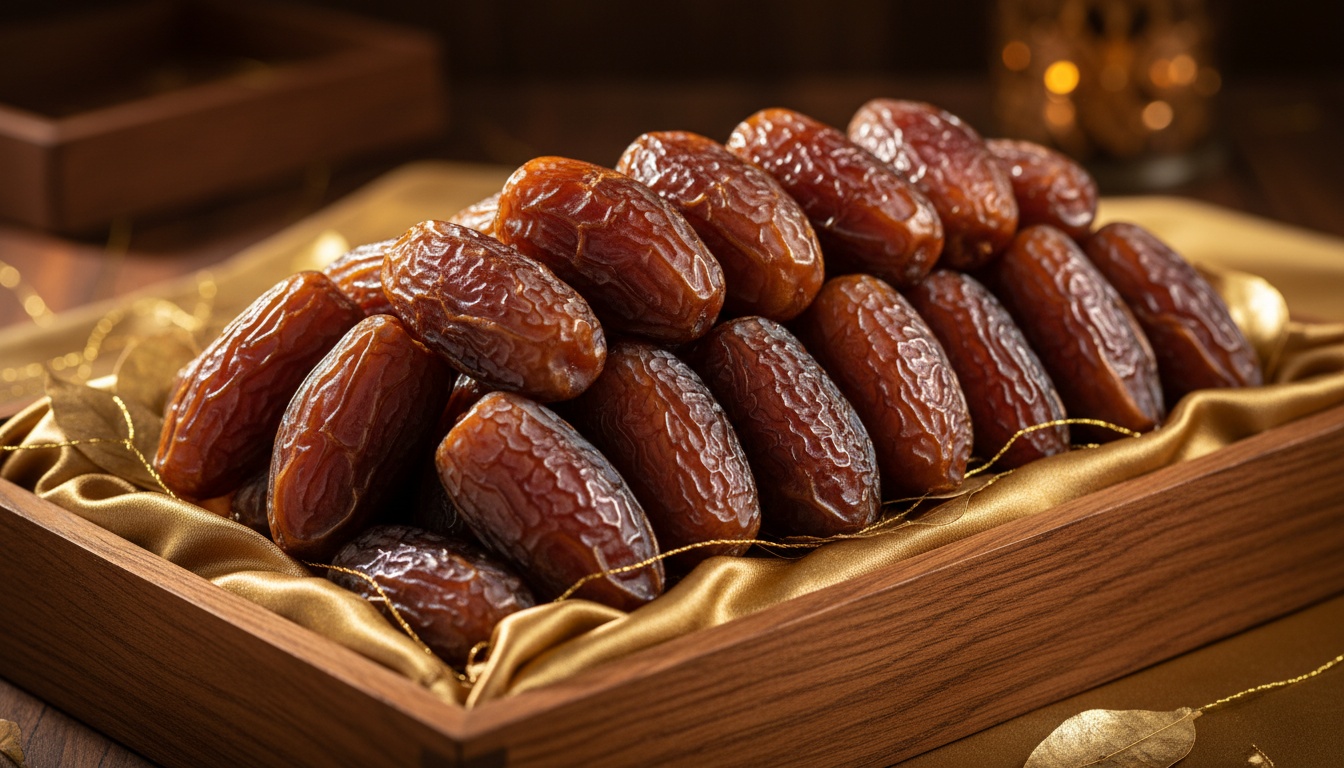
Anbara — labelled "Amber" in Madinah's date markets — is the largest commercial variety grown in the oasis, and one of the rarest. The palm is expensive to propagate, yields modestly (a mature tree rarely exceeds seventy kilograms a season) and matures late, so fruit reaches the market from roughly September onwards in limited quantity. The date itself is unmistakable: a long, oblong fruit with glossy red-brown skin, thin enough that careless handling shows immediately, over tender flesh with a mild, restrained sweetness and a seed that is small out of all proportion to the fruit around it. That flesh-to-seed ratio is the variety's entire commercial argument — a kilogram of Anbara contains more edible date and less stone than a kilogram of almost anything else in the souk. It is classed semi-dry: harvested at an advanced stage of ripeness, the flesh firm enough to survive handling but nothing like a hard dry date. Because size is the product, Anbara is graded by count — pieces per kilogram — with jumbo lots running at or under forty-five pieces and uniformity tolerances written into any serious contract. Export lots ship under SFDA approval with HACCP or ISO 22000 processing certification and halal documentation as standard; gift-grade lots add hand-selection for unbroken skin and consistent colour.
Anbara is a gifting date, and it should be bought as one. The buyers who make money on it are premium retailers, hamper and gift-box packers, and hospitality buyers serving the Ramadan, Hajj and Umrah trade, where a tray of visibly enormous Madinah dates does work no smaller variety can. It sits in the premium tier alongside Mabroom — typically at a modest premium to it, reflecting scarcity — and below Ajwa, whose price is driven by religious significance rather than size. If your end use is chopping, stuffing lines or paste, do not buy Anbara: you would be paying for size and appearance the process destroys, and Khudri or Sagai does the job at a fraction of the cost. Contract on count and uniformity, not adjectives — "jumbo" means nothing until it is expressed as pieces per kilogram with a tolerance. Insist on unpitted fruit; the thin skin does not tolerate pitting machinery, and pitted Anbara offered cheap is usually damaged stock or another variety altogether. Ship reefer at 0–5 °C for any long transit — the semi-dry flesh travels better than a soft date, but ambient container heat darkens the skin and costs you the amber colour the shop shelf is paying for. Book early: the crop is small, allocations from good Madinah growers clear within weeks of harvest, and late-season buyers take what is left.
Excluded origins are not offered, including product re-exported, blended or re-processed through a third country. Every lot moves with a certificate of origin naming the producing plant, mine or grower country, and nothing is quoted before the seller and loading point are known.
Indicative reference
$4,800–7,000 USD / MT
as at September 2026
Reference level only — not an offer, and reviewed quarterly. Levels shown are as at September 2026. Firm pricing is quoted per RFQ, subject to volume, terms and inspection.
Typical Specification
Specifications are indicative and adjusted to the agreed contract and destination requirements. Final spec confirmed on COA / SGS.
Available Grades
Applications
- Premium gifting (Ramadan, Hajj & Umrah)
- Speciality and luxury retail
- Hotel and hospitality date trays
- Corporate gift assortments
- Table dates for direct consumption
Category
Agri-Foods, Spices & Nuts
Incoterms
FOB · CFR · CIF
Pricing basis
USD / MT
Inspection
SGS / Intertek at load port
Anbara (Amber) Dates — buyer questions
How do I verify a lot is genuine Madinah Anbara and not a look-alike?
Start with the physical spec: genuine Anbara is an oblong fruit with glossy red-brown skin, tender flesh and a conspicuously small seed — if the seed is large or the fruit rounded, you are looking at another variety. Then check the paperwork and the arithmetic. Anbara is a low-yield palm grown in limited quantity around Madinah, so an offer of hundreds of tonnes at Safawi money should fail on its own logic. We supply against Saudi certificates of origin, SFDA export documentation and packer traceability to Madinah farms, and we encourage buyers to cut cartons on arrival against the contracted count per kilogram.
How should Anbara be specified on a contract?
Numerically, because the one variable that moves the price is size. Fix pieces per kilogram by grade — jumbo at or under forty-five — with a uniformity tolerance of around ten per cent within grade, a minimum percentage of fruit with unbroken skin, and moisture in the semi-dry band of roughly 18–22 per cent. Specify unpitted: Anbara's thin skin is damaged by pitting machinery, so pitted offers deserve scrutiny. A contract that simply says "premium Anbara" gives the packer every incentive to blend counts, and with this variety a blended count is exactly what you paid a premium to avoid.
What storage and shipping regime does Anbara need?
Chilled, ideally 0–5 °C from packhouse to shelf. As a semi-dry date it is more forgiving than soft varieties and will survive a short ambient hop, but sustained container heat darkens the red-brown skin and softens the flesh — and with Anbara you are selling appearance. For UK and European destinations we ship reefer as standard. Properly stored, expect around twelve months of shelf life; fruit intended for the Ramadan gifting peak should be landed and in cold store well before the season begins. All export lots are pest-treated at origin and packed to exclude reinfestation in transit.
What is the minimum order, and what actually drives the price?
For bulk cartons we typically work from around one tonne, consolidated with other Saudi date varieties into mixed reefer containers, up to full container loads; gift-box programmes can start smaller by arrangement. Price is driven first by count — each step down in pieces per kilogram costs real money — and then by crop timing. Anbara is a late, small harvest, so early-booked allocations price tighter than spot lots chased in December. Expect wholesale FOB in the region of $4,800–7,000 per tonne depending on grade and season: above Safawi and Sukkari, near or slightly above Mabroom, and below Ajwa.
Ready to source Anbara?
Send your quantity, specification, preferred Incoterms and destination port. Qualified requirements receive a workable offer against verified supply.
Have Anbara to sell? Submit an offer — we'll match it against live buyer demand.
More in Saudi Dates
Ajwa Dates
Madinah-only origin — graded by count, skin & provenance
Ajwa Al Aaliya Dates
Named-farm Ajwa from Madinah's Al-Aaliya basalt belt
Safawi Dates
Madinah semi-dry, near-black, ambient-stable · FOB Jeddah
Mabroom Dates
Madinah's long date — graded on length, sold on looks
Sagai Dates
Two-tone Najd semi-dry — graded by piece weight & count
Sukkari Dates
Qassim golden Sukkari — soft (rutab) & mufattal, by count
Khalas Dates
Al-Ahsa amber semi-dry, 60–90 count, ambient-stable
Khudri Dates
Semi-dry Saudi volume date — size-graded, year-round FCL
Saudi Medjool Dates
AlUla & Al-Jouf Medjool by calibre and skin grade
Barni Dates
Semi-dry Madinah date — Grade 1/2, Al-Ais provenance
Shalabi Dates
Scarce Madinah variety — lot-certified, part-load supply
Rabia Dates
Madinah value date graded on count, moisture and defects
Mashrooq Dates
Mid-tier Madinah date — caramel-sweet, sold by count band
Stuffed & Chocolate Dates
Stuffed & enrobed OEM lines · 18–20°C chocolate cool chain