
Khudri Dates
Semi-dry Saudi volume date — size-graded, year-round FCL
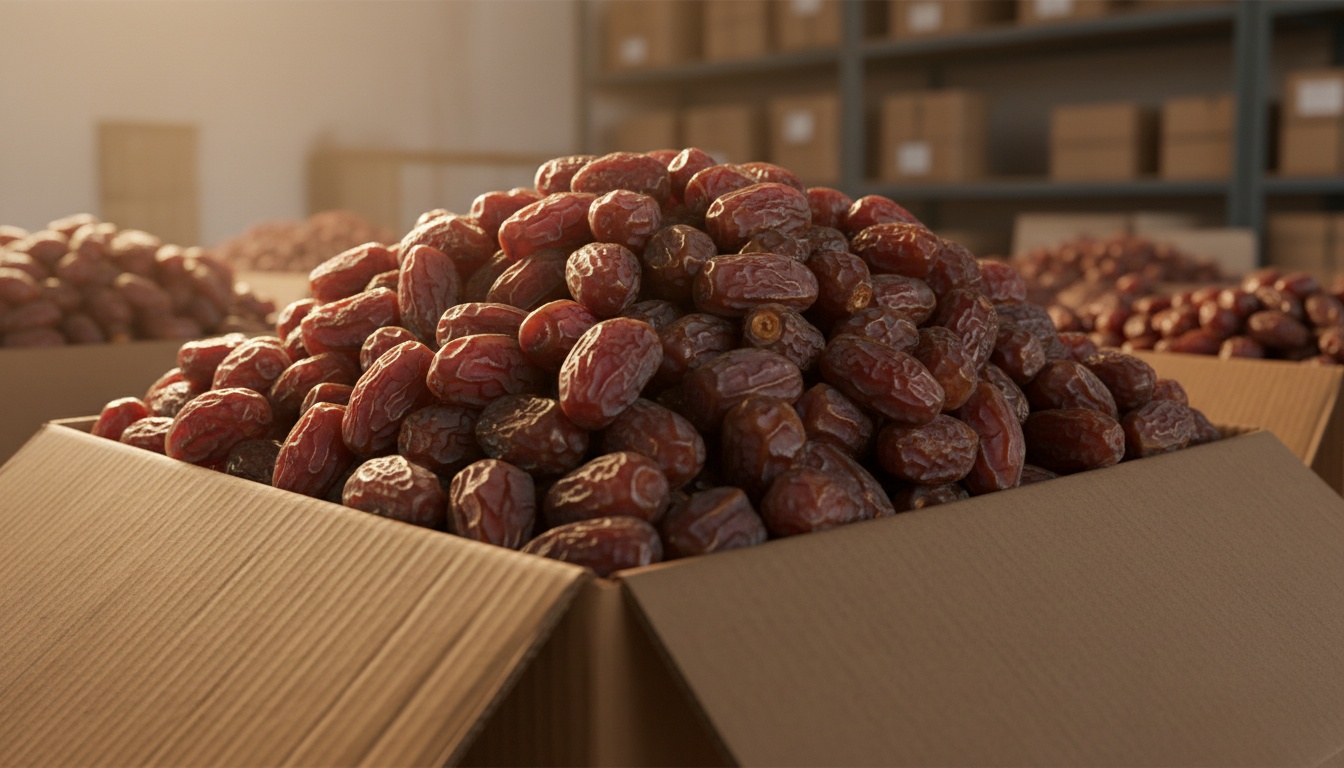
Khudri — spelt khodari or khudary on plenty of invoices, all the same fruit — is the highest-volume date in the Saudi export book. It grows across the central Kingdom, principally around Al-Kharj and Al-Ghat in the Riyadh region, with meaningful production around Madinah, and it is the variety Saudi packers can supply in full-container quantities every month of the year. The fruit is dark brown, elongated and visibly wrinkled, with firm, chewy flesh and a plain caramel sweetness. Commercially, the point is its moisture class: Khudri is a semi-dry date, typically packed at 14–18% moisture, which makes it ambient-tolerant and forgiving in transit in a way soft varieties never are. Harvest runs from late August into October; fruit is then held in cold store and drawn down across the year, so a January shipment is normal rather than a compromise. Grading is by size — Jumbo, Large, Medium and Small, expressed as a count per kilogramme — and by condition, with Grade A reserved for whole, uniform, unblemished fruit and a processing grade covering broken and off-size fruit. Export cartons move under SFDA registration with a phytosanitary certificate and Halal certification, and the better packers hold HACCP or ISO 22000 accreditation; confirm the disinfestation method on the health certificate, since several destination markets no longer accept methyl bromide fumigation.
Khudri is the correct answer when the brief reads "good Saudi date at the lowest landed cost" — and the wrong answer for almost anything else. It sits at the bottom of the Saudi price ladder: below Khalas, well below Sukkari and Safawi, and at a small fraction of Ajwa, which is exactly why it dominates price-led retail packs, Ramadan volume promotions, foodservice and the ingredient trade in paste, chopped dates and bakery fillings. The classic spec error runs in both directions. Dressing Khudri in a gift box against Ajwa or Mabroom disappoints the end customer; equally, paying the Jumbo premium on fruit destined for a grinder wastes money that Medium, Small or processing grade would have saved — once the fruit is chopped or pasted, the size premium is gone. What moves the price is size grade first, then crop year and the Ramadan demand spike; buyers who fix volume in October–December, straight off harvest, generally beat those chasing stock in the two months before Ramadan. On logistics, dry containers are acceptable for cooler-season loadings, but specify reefer at 0–4 °C for summer shipments out of Jeddah and for any stock you intend to hold, because warm storage accelerates the surface sugaring that leaves older Khudri looking grey and crystallised on shelf. Contract current-season crop explicitly; a 20 ft box takes roughly 18 tonnes in bulk cartons.
Excluded origins are not offered, including product re-exported, blended or re-processed through a third country. Every lot moves with a certificate of origin naming the producing plant, mine or grower country, and nothing is quoted before the seller and loading point are known.
Indicative reference
$1,000–1,800 USD / MT
as at September 2026
Reference level only — not an offer, and reviewed quarterly. Levels shown are as at September 2026. Firm pricing is quoted per RFQ, subject to volume, terms and inspection.
Typical Specification
Specifications are indicative and adjusted to the agreed contract and destination requirements. Final spec confirmed on COA / SGS.
Available Grades
Applications
- Price-led retail date packs
- Date paste & syrup manufacture
- Chopped dates for bakery & cereals
- Ramadan volume programmes
- Foodservice & catering bulk
Category
Agri-Foods, Spices & Nuts
Incoterms
FOB · CFR · CIF
Pricing basis
USD / MT
Inspection
SGS / Intertek at load port
Khudri Dates — buyer questions
How are Khudri dates graded, and which grade should I actually buy?
By size — Jumbo, Large, Medium and Small, quoted as a count per kilogramme — and by condition, with Grade A covering whole, uniform fruit and processing grade the rest. Match the grade to the application, not the budget line. Retail packs where the fruit is seen justify Large or Jumbo; anything going to a grinder, chopper or bakery line should be Medium, Small or processing grade, because the size premium disappears the moment the fruit is cut. The most common overspend we see on Khudri contracts is Jumbo fruit bought for paste.
Are Khudri, Khodari and Khudary different dates?
No — one variety, three transliterations from the Arabic, and you will see all three across invoices, health certificates and cartons, sometimes within a single shipment file. What matters is that the variety name reads consistently on the contract, the packing list and the phytosanitary certificate, because a customs officer who sees "Khodari" on one document and "Khudri" on another can hold the consignment. Fix one spelling in the contract and require the packer to mirror it on every export document.
Do Khudri dates need refrigerated shipping?
Not always — that tolerance is part of what you are buying. As a semi-dry date at roughly 14–18% moisture, Khudri handles dry-container shipment in the cooler months where a soft date would not. For summer loadings out of Jeddah, and for any stock intended to sit more than a few weeks after arrival, book a reefer at 0–4 °C: heat accelerates surface sugaring, which turns the skin grey and crystalline and is the main reason Khudri gets rejected at retail. Held chilled, it keeps condition for a full year.
What moves the Khudri price, and when should I book?
Khudri is the cheapest of the mainstream Saudi export varieties — below Khalas, far below Sukkari, Safawi or Ajwa — so the absolute numbers are small but the percentage swings are not. Size grade sets the base; crop year and the Ramadan cycle move it. Harvest lands August to October, and buyers who fix full-container volume in October–December routinely pay less than those competing for stock in the eight weeks before Ramadan, when Gulf, South Asian and UK demand peaks together. Most packers work to a one-pallet minimum for trials and full FCL — about 18 tonnes — for programme pricing.
Ready to source Khudri?
Send your quantity, specification, preferred Incoterms and destination port. Qualified requirements receive a workable offer against verified supply.
Have Khudri to sell? Submit an offer — we'll match it against live buyer demand.
More in Saudi Dates
Ajwa Dates
Madinah-only origin — graded by count, skin & provenance
Ajwa Al Aaliya Dates
Named-farm Ajwa from Madinah's Al-Aaliya basalt belt
Anbara (Amber) Dates
Madinah's largest date — graded on count, priced on size
Safawi Dates
Madinah semi-dry, near-black, ambient-stable · FOB Jeddah
Mabroom Dates
Madinah's long date — graded on length, sold on looks
Sagai Dates
Two-tone Najd semi-dry — graded by piece weight & count
Sukkari Dates
Qassim golden Sukkari — soft (rutab) & mufattal, by count
Khalas Dates
Al-Ahsa amber semi-dry, 60–90 count, ambient-stable
Saudi Medjool Dates
AlUla & Al-Jouf Medjool by calibre and skin grade
Barni Dates
Semi-dry Madinah date — Grade 1/2, Al-Ais provenance
Shalabi Dates
Scarce Madinah variety — lot-certified, part-load supply
Rabia Dates
Madinah value date graded on count, moisture and defects
Mashrooq Dates
Mid-tier Madinah date — caramel-sweet, sold by count band
Stuffed & Chocolate Dates
Stuffed & enrobed OEM lines · 18–20°C chocolate cool chain