
Rabia Dates
Madinah value date graded on count, moisture and defects
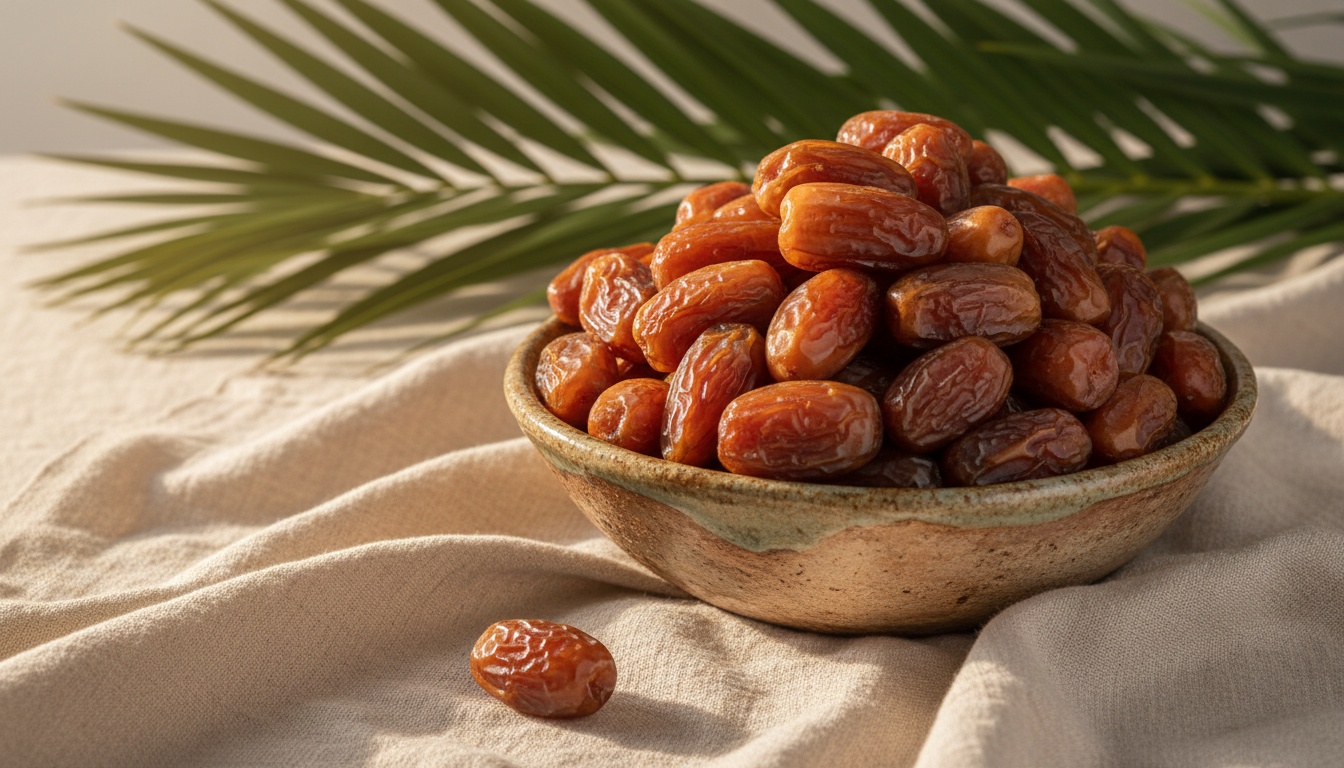
Rabia — written rabeeah or rabee'a on some export documents — is one of the workhorse varieties of the Madinah date gardens: a smallish, dark brownish-black fruit with a wrinkled, weathered-looking skin and a soft, sweet flesh that cures down to a stable tamr. It is among the more abundantly produced dates in the region, and that abundance defines how it trades. Where Ajwa is contracted on provenance and Anbara on size, Rabia is contracted on plain physical grade: count per kilogram, moisture at loading, colour uniformity, and the percentage of loose skins, splits and infested fruit tolerated in the lot. A typical export spec runs 16–20% moisture for fruit cured to semi-dry stability, foreign matter under half a percent, and pest and mould limits verified by SGS or Intertek inspection at packing. Grading in practice is done at the Madinah packing houses into premium, first and second carton grades, with the smallest and most blemished fruit diverted to pitted and paste use. Lots ship with phytosanitary certification, Halal certification and Saudi export documentation, and the harvest reaches the market from late summer, with cured fruit available for shipment through the autumn and, from cold store, most of the year. The buyer's first discipline with Rabia is to insist the variety is named on the contract — 'Madinah dates' unspecified is an invitation to receive whatever the packer needs to move, and Rabia's value case only works when you know that is what you are getting.
Rabia is a value buy, and it should be bought as one. Its natural customers are importers serving diaspora retail in the UK, Europe and South Asia, packers building mixed-variety gift assortments where Ajwa and Safawi headline and Rabia fills the tray, and Ramadan volume programmes where the requirement is a genuine Madinah date at a price a multipack can carry. On the Madinah price lists it sits well below Ajwa, below Safawi and Sukkari, and in the value tier above Khudri, and the correct way to use that position is to let Rabia do the volume work an Ajwa budget cannot. The common spec error runs the other way: paying a provenance-flavoured premium because the fruit is 'from Madinah'. The premium in this trade attaches to the variety, not the postcode, and Rabia priced near Safawi is simply mispriced. Storage and shipping are straightforward for fruit cured to the semi-dry range: ambient container shipment is normal, with cool dry storage below 18°C giving around twelve months of life. Softer, higher-moisture pickings need chilled handling and should be priced and shipped as a different product, so fix the moisture band in the contract rather than accepting 'soft' as a description. For summer sailings out of Jeddah, reefer at 10–15°C is cheap insurance against syruping and sugar spotting in the box. CBIL contracts Rabia by named grade from Madinah packers, with independent inspection of moisture, count and defects before loading.
Excluded origins are not offered, including product re-exported, blended or re-processed through a third country. Every lot moves with a certificate of origin naming the producing plant, mine or grower country, and nothing is quoted before the seller and loading point are known.
Indicative reference
$1,300–2,100 USD / MT
as at September 2026
Reference level only — not an offer, and reviewed quarterly. Levels shown are as at September 2026. Firm pricing is quoted per RFQ, subject to volume, terms and inspection.
Typical Specification
Specifications are indicative and adjusted to the agreed contract and destination requirements. Final spec confirmed on COA / SGS.
Available Grades
Applications
- Diaspora & ethnic retail
- Mixed-variety gift assortments
- Ramadan volume programmes
- Multipack & value retail lines
- Date paste & bakery (out-sorts)
Category
Agri-Foods, Spices & Nuts
Incoterms
FOB · CFR · CIF
Pricing basis
USD / MT
Inspection
SGS / Intertek at load port
Rabia Dates — buyer questions
Is Rabia a soft date or a semi-dry date?
It depends on the cure, which is why the moisture band belongs in the contract rather than the description. Rabia picked early and lightly cured is soft, needs chilled handling and has a short ambient life; fruit cured down to the 16–20% range travels and stores like a semi-dry date in ordinary containers. The two are different products with different logistics costs, and 'soft Madinah dates' on an offer sheet tells you nothing about which you will receive. Fix a moisture ceiling at loading, verified by independent inspection, and the storage question answers itself.
How do I know a carton of Rabia is actually Rabia?
Not by looking at it. Several Madinah varieties are small, dark and wrinkled once cured, and visual identification at destination is unreliable even for experienced buyers. The protection is contractual: the variety named on the contract and packing declaration, a named packing house, and pre-shipment inspection that samples the lot before the container is sealed. Unnamed 'Madinah dates' is the commonest way mixed or substituted fruit enters the market — the label is technically true and commercially meaningless. If a counterparty resists naming the variety and packer on the documents, that reluctance is the answer.
Where does Rabia sit against Ajwa, Safawi and Khudri on price?
In the value tier. Ajwa trades on provenance at a multiple of everything else in Madinah; Safawi, Sagai and Sukkari occupy the middle of the list; Rabia sits below them and above Khudri, the region's cheapest volume date. Used correctly, that position is its strength — it does the volume work in an assortment or a Ramadan multipack that an Ajwa budget cannot. The error to avoid is paying a Madinah-provenance premium for it: the premium attaches to the variety, not the region, and Rabia offered at Safawi money is overpriced.
What is the minimum order and how does Rabia ship?
The economics work at container-load: a 20-foot container takes roughly 10–12 tonnes of cartonned dates depending on pack format. Smaller trial quantities can sometimes be consolidated through Jeddah at a higher unit cost, and we would rather arrange a one-pallet sample shipment than have a buyer commit a container to an unfamiliar variety. Ambient shipment is standard for properly cured fruit; for June-to-September sailings we recommend reefer at 10–15°C to protect against syruping. Quotes run FOB Jeddah, CFR or CIF destination, with inspection, phytosanitary and Halal documentation included.
Ready to source Rabia?
Send your quantity, specification, preferred Incoterms and destination port. Qualified requirements receive a workable offer against verified supply.
Have Rabia to sell? Submit an offer — we'll match it against live buyer demand.
More in Saudi Dates
Ajwa Dates
Madinah-only origin — graded by count, skin & provenance
Ajwa Al Aaliya Dates
Named-farm Ajwa from Madinah's Al-Aaliya basalt belt
Anbara (Amber) Dates
Madinah's largest date — graded on count, priced on size
Safawi Dates
Madinah semi-dry, near-black, ambient-stable · FOB Jeddah
Mabroom Dates
Madinah's long date — graded on length, sold on looks
Sagai Dates
Two-tone Najd semi-dry — graded by piece weight & count
Sukkari Dates
Qassim golden Sukkari — soft (rutab) & mufattal, by count
Khalas Dates
Al-Ahsa amber semi-dry, 60–90 count, ambient-stable
Khudri Dates
Semi-dry Saudi volume date — size-graded, year-round FCL
Saudi Medjool Dates
AlUla & Al-Jouf Medjool by calibre and skin grade
Barni Dates
Semi-dry Madinah date — Grade 1/2, Al-Ais provenance
Shalabi Dates
Scarce Madinah variety — lot-certified, part-load supply
Mashrooq Dates
Mid-tier Madinah date — caramel-sweet, sold by count band
Stuffed & Chocolate Dates
Stuffed & enrobed OEM lines · 18–20°C chocolate cool chain