
Mabroom Dates
Madinah's long date — graded on length, sold on looks
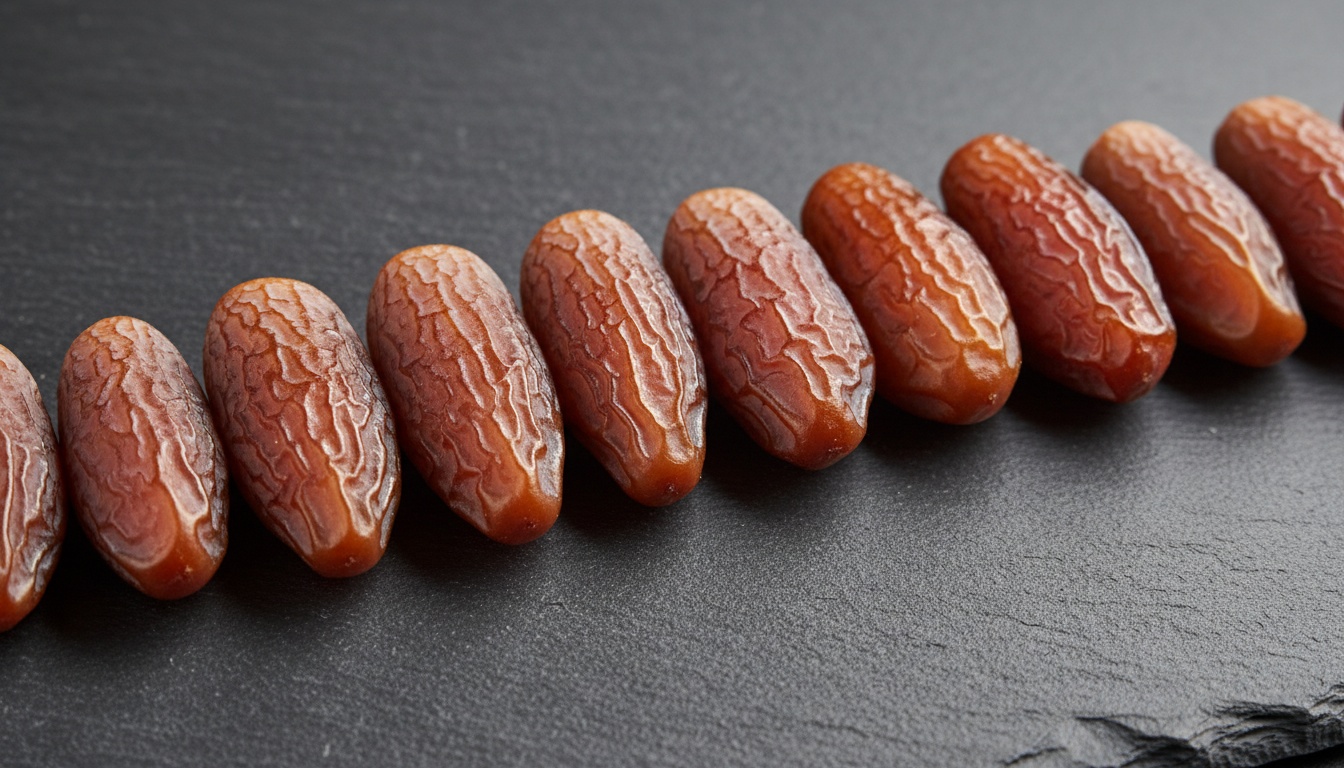
Mabroom is Madinah's long date: a slender, elongated fruit, reddish-brown to dark amber, with a thin skin over firm, chewy flesh and a restrained toffee sweetness — noticeably less sugary than Sukkari or Khalas. The name derives from the Arabic for "twisted" or "compacted", a reference to the fruit's dense, fibrous texture. It is grown almost entirely in the palm groves of Al Madinah Al Munawwarah, harvested at full tamar stage from late August into October, then disinfested, length-sorted and packed for shipment through the year. The commercial point a buyer must grasp is that Mabroom is graded on the eye, not the palate. Because the fruit is bought to be displayed — laid out in gift trays and presentation boxes — packers sort on length, straightness, colour match and skin integrity before anything else. Grade 1 stock is long (typically 4.5–6 cm), uniform and unblemished; Grade 2 carries the same flesh in shorter or mixed-length fruit with minor skin creasing; Grade 3 is visually irregular. The eating difference between the top and bottom of that ladder is marginal — the price difference is not. Reputable Saudi packers ship under SFDA export registration with HACCP or ISO 22000 systems and Halal documentation as standard; insist on the packing-house registration number appearing on the health certificate, because "Madinah Mabroom" commands enough of a premium to attract relabelled fruit from elsewhere.
Mabroom's natural buyers are gift-box packers, premium grocers and the hospitality trade — anyone selling the date whole and visible. Demand peaks hard around Ramadan and the Hajj and Umrah seasons, when Mabroom fills the tier of the gifting market directly below Ajwa: pilgrims and corporate buyers who want a recognisably premium Madinah date without Ajwa's price. In the Madinah market it trades at roughly half Ajwa's level and a clear step above Safawi and Sagai, and export pricing follows the same ladder. Where the premium is wasted is ingredient use. Chopped into a bar, blended into paste or baked into a loaf, Mabroom's length, colour match and skin finish — the very things you paid for — disappear; Sagai, Khalas or Khudri deliver the same function at a fraction of the cost. If a supplier offers "industrial-grade Mabroom" at a tempting number, that is short, broken-skin fruit and should be priced against Khudri, not against Grade 1. Logistically the variety is forgiving: a semi-dry date at under 20 per cent moisture, it is ambient-stable for months and ships in dry containers through the cooler half of the year, though summer transits justify a reefer at 0–5 °C to prevent skin darkening and surface sugaring — cosmetic faults, but fatal on a fruit sold for its looks. For long holding, chilled storage keeps display quality well past twelve months.
Excluded origins are not offered, including product re-exported, blended or re-processed through a third country. Every lot moves with a certificate of origin naming the producing plant, mine or grower country, and nothing is quoted before the seller and loading point are known.
Indicative reference
$3,500–5,500 USD / MT
as at September 2026
Reference level only — not an offer, and reviewed quarterly. Levels shown are as at September 2026. Firm pricing is quoted per RFQ, subject to volume, terms and inspection.
Typical Specification
Specifications are indicative and adjusted to the agreed contract and destination requirements. Final spec confirmed on COA / SGS.
Available Grades
Applications
- Premium gift boxes & presentation trays
- Ramadan, Hajj & Umrah gifting trade
- Premium retail & speciality grocery
- Hotel & hospitality service
- Dates-and-nuts assortments
Category
Agri-Foods, Spices & Nuts
Incoterms
FOB · CFR · CIF
Pricing basis
USD / MT
Inspection
SGS / Intertek at load port
Mabroom Dates — buyer questions
How do I know I am getting genuine Madinah Mabroom?
Start with the paperwork: the phytosanitary and health certificates should name a Madinah-region packing house with an SFDA export registration number, and a serious packer can show grove sourcing on request. Then check the fruit itself. True Mabroom is long, slim and slightly tapered, with fine longitudinal wrinkling and reddish-brown skin; short, plump or very dark fruit sold under the name is usually another variety or bottom-grade stock. Finally, sanity-check the price — genuine Grade 1 Mabroom cannot profitably sell at Khudri money, and an offer far below the market ladder is telling you something.
What actually separates Grade 1 from Grade 2, and is it worth paying for?
Length, uniformity and skin finish — almost nothing else. Grade 1 cartons are length-matched, colour-matched and free of creasing or scarring; Grade 2 is the same flesh in shorter or mixed sizes with minor cosmetic faults. If your product is a presentation box, tray or premium retail pack where the fruit is seen before it is eaten, Grade 1 earns its premium immediately. If the date will be pitted, chopped or otherwise hidden, Grade 2 — or a cheaper variety entirely — is the correct buy. Paying Grade 1 money for fruit nobody sees is the classic Mabroom spec error.
Does Mabroom need cold-chain shipping, and how long does it keep?
As a semi-dry variety at under 20 per cent moisture, Mabroom is ambient-stable and routinely ships in dry containers from October to April. For summer sailings we recommend reefer carriage at 0–5 °C: heat will not spoil the fruit, but it accelerates skin darkening and surface sugar crystallisation, which downgrades display stock. Once landed, keep it cool and dry at around 70–75 per cent relative humidity; ambient storage holds quality for several months, chilled storage for twelve months or more. Vacuum-packed retail units extend shelf life further and prevent moisture migration in mixed loads.
What are typical MOQs, packaging and lead times?
Most Saudi packers will quote from a single pallet (roughly 500 kg–1 MT) for trial orders, though pricing only becomes competitive at part-container and full-container volume — a 20-foot box takes around 10–14 MT in cartons depending on pack format. Standard export packs are 3, 5 and 10 kg cartons, with gift boxes and vacuum packs made to order. Lead times run two to four weeks ex-Madinah outside peak season, but Ramadan demand clears Grade 1 stock early: gifting-trade buyers should contract by late autumn for spring delivery, or accept Grade 2 and mixed-length fruit.
Ready to source Mabroom?
Send your quantity, specification, preferred Incoterms and destination port. Qualified requirements receive a workable offer against verified supply.
Have Mabroom to sell? Submit an offer — we'll match it against live buyer demand.
More in Saudi Dates
Ajwa Dates
Madinah-only origin — graded by count, skin & provenance
Ajwa Al Aaliya Dates
Named-farm Ajwa from Madinah's Al-Aaliya basalt belt
Anbara (Amber) Dates
Madinah's largest date — graded on count, priced on size
Safawi Dates
Madinah semi-dry, near-black, ambient-stable · FOB Jeddah
Sagai Dates
Two-tone Najd semi-dry — graded by piece weight & count
Sukkari Dates
Qassim golden Sukkari — soft (rutab) & mufattal, by count
Khalas Dates
Al-Ahsa amber semi-dry, 60–90 count, ambient-stable
Khudri Dates
Semi-dry Saudi volume date — size-graded, year-round FCL
Saudi Medjool Dates
AlUla & Al-Jouf Medjool by calibre and skin grade
Barni Dates
Semi-dry Madinah date — Grade 1/2, Al-Ais provenance
Shalabi Dates
Scarce Madinah variety — lot-certified, part-load supply
Rabia Dates
Madinah value date graded on count, moisture and defects
Mashrooq Dates
Mid-tier Madinah date — caramel-sweet, sold by count band
Stuffed & Chocolate Dates
Stuffed & enrobed OEM lines · 18–20°C chocolate cool chain