
Saudi Medjool Dates
AlUla & Al-Jouf Medjool by calibre and skin grade
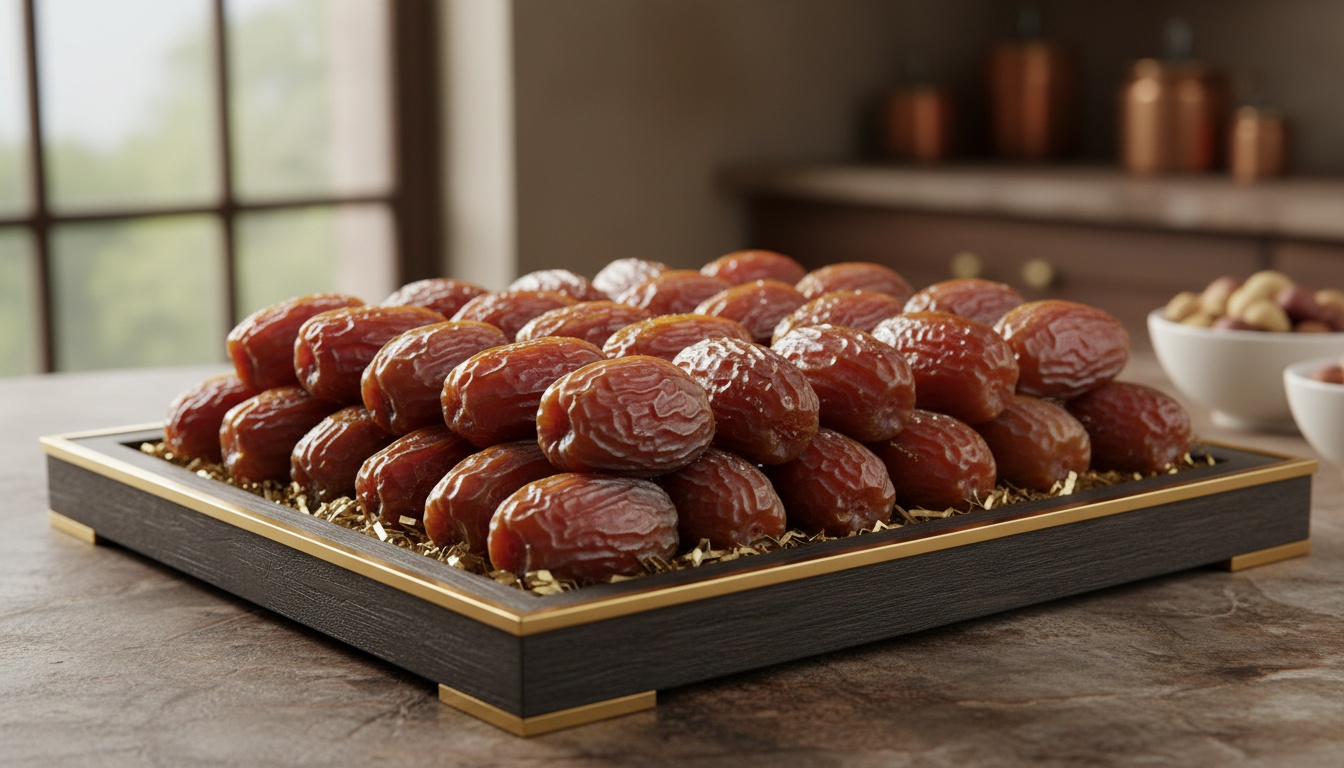
Medjool is not native to Saudi Arabia — the cultivar came out of Morocco via California — but the Kingdom's northwest has become one of the fastest-growing Medjool origins in the trade. The commercial plantings sit in AlUla, in Al-Jouf around Sakaka, and in Tabuk, where high-altitude desert winters and very low humidity suit the variety, and where corporate-scale farms have brought thousands of hectares into bearing over the past decade. Harvest runs August to October. The grading language is the same one Jordan and California use, and buyers should insist on it: calibre first, defined in grams per piece — Jumbo at roughly 23 g and up (no more than 43 pieces per kg), Large at 18–23 g (44–56 per kg), Medium at 15–18 g (56–67 per kg) — then skin condition, expressed as a maximum percentage of skin separation, wrinkling and blemish per carton. Saudi Medjool is a soft date at roughly 18–24% moisture, which places it firmly in the cold-chain class: it is picked at tamar stage, cleaned, graded and moved into chilled storage at origin, and it should stay chilled or frozen until retail. Export lots ship against SGS or Intertek pre-shipment certification of calibre, moisture, skin tolerance, foreign matter and infestation, with phytosanitary, Halal and, on a growing share of AlUla fruit, organic documentation. Packing is the standard 5 kg bulk carton for repackers, with retail trays and gift formats packed at origin on request.
The commercial case for Saudi Medjool is landed cost. The orchards are young, yields are climbing, the state is pushing date exports hard, and growers price to win share from the established origins — on like-for-like Large and Medium calibre, Saudi fruit typically lands meaningfully below Jordan Valley and well below Californian. That makes it the right buy for price-led retail programmes, wholesale repacking and the Ramadan volume trade across South Asia, the Far East and the Gulf, where buyers ask for Medjool by name but shop the origin on price. Where the established origins still earn their premium is the very top of the spec: Jumbo and Super Jumbo presentation-box fruit with tight skin tolerances, where mature Jordan Valley palms and Californian handling still deliver a more consistent large calibre, and where European and North American retail programmes are slow to switch origin. Our advice is to sample against calibre and skin tolerance rather than origin reputation — a well-run AlUla Large at a Saudi price frequently beats a mid-grade Jordanian carton costing more. Within the Saudi export range Medjool prices in the premium tier alongside Anbara and Mabroom — well above Sukkari, Khalas and Khudri, though below Ajwa — so treat it as a considered purchase, not a volume filler. Ship reefer at 0–5 °C, or frozen at −18 °C for long-hold inventory; a broken cold chain shows up as lifted skin and surface sugaring, and with it goes the appearance premium you paid for. The standard contract unit is a 13–14 MT reefer container FOB Jeddah or a northwest port.
Excluded origins are not offered, including product re-exported, blended or re-processed through a third country. Every lot moves with a certificate of origin naming the producing plant, mine or grower country, and nothing is quoted before the seller and loading point are known.
Indicative reference
$3,500–6,200 USD / MT
as at September 2026
Reference level only — not an offer, and reviewed quarterly. Levels shown are as at September 2026. Firm pricing is quoted per RFQ, subject to volume, terms and inspection.
Typical Specification
Specifications are indicative and adjusted to the agreed contract and destination requirements. Final spec confirmed on COA / SGS.
Available Grades
Applications
- Retail repacking & own-label programmes
- Ramadan & festive gifting
- HORECA & fine-food counters
- Stuffed-date & chocolate-enrobed confectionery
- Whole-fruit snacking packs
Category
Agri-Foods, Spices & Nuts
Incoterms
FOB · CFR · CIF
Pricing basis
USD / MT
Inspection
SGS / Intertek at load port
Saudi Medjool Dates — buyer questions
Is Saudi Medjool the same variety as Jordanian or Californian Medjool?
Genetically, yes — it is the same cultivar, which travelled from Morocco to California and from there to the Jordan Valley and Saudi Arabia. What differs is orchard age, agronomy and handling. Younger Saudi palms throw a somewhat higher share of Medium and Large calibre and less Jumbo than mature Jordan Valley plantations, and packhouse discipline varies more between suppliers. The practical answer is to buy the carton, not the flag: contract on grams per piece and a skin-separation tolerance, inspect a pre-shipment sample, and Saudi fruit that meets the spec is the same product at lower money.
What should a Saudi Medjool contract actually specify?
Calibre in grams per piece or pieces per kilogram — 'Jumbo' alone is not a spec, because packers can stretch the band. Then a skin tolerance: the maximum percentage of fruit with skin separation, wrinkling or blemish per carton, typically 5% for presentation grade and 10% for standard retail. Add a moisture band (18–24%), a foreign-matter maximum, absence of live infestation, and pre-shipment inspection by SGS or Intertek naming those exact parameters. The most common dispute on Medjool is calibre spread inside a 'Large' carton, and a written grams-per-piece band backed by an inspection certificate is what settles it.
What cold chain does Saudi Medjool need in transit and storage?
Treat it as a chilled product from packhouse to shelf. Ship reefer at 0–5 °C; for long-hold inventory, store frozen at −18 °C, where the fruit keeps for a year or more without meaningful loss. What ambient transit costs you is appearance, which is the entire premium: warmth lifts the skin, drives surface sugaring, and at the top of the moisture band can start fermentation. Saving freight by moving a soft 18–24% moisture date in a dry container is a false economy — the fruit arrives edible but unsellable at the grade you paid for.
What is the minimum order, and what actually moves the price?
The standard contract unit is a 20 ft reefer of roughly 13–14 MT in 5 kg cartons, FOB Jeddah or a northwest port, and full containers get the best money; trial orders move as consolidated reefer pallets at a higher per-kilogram rate. Price is driven first by calibre — each step from Medium to Large to Jumbo adds roughly a dollar per kilogram — then by skin grade, harvest timing (early contracts against the August–October harvest price best) and conventional versus organic status. CFR and CIF quotes carry reefer freight, which runs materially above dry-box rates.
Ready to source Saudi Medjool?
Send your quantity, specification, preferred Incoterms and destination port. Qualified requirements receive a workable offer against verified supply.
Have Saudi Medjool to sell? Submit an offer — we'll match it against live buyer demand.
More in Saudi Dates
Ajwa Dates
Madinah-only origin — graded by count, skin & provenance
Ajwa Al Aaliya Dates
Named-farm Ajwa from Madinah's Al-Aaliya basalt belt
Anbara (Amber) Dates
Madinah's largest date — graded on count, priced on size
Safawi Dates
Madinah semi-dry, near-black, ambient-stable · FOB Jeddah
Mabroom Dates
Madinah's long date — graded on length, sold on looks
Sagai Dates
Two-tone Najd semi-dry — graded by piece weight & count
Sukkari Dates
Qassim golden Sukkari — soft (rutab) & mufattal, by count
Khalas Dates
Al-Ahsa amber semi-dry, 60–90 count, ambient-stable
Khudri Dates
Semi-dry Saudi volume date — size-graded, year-round FCL
Barni Dates
Semi-dry Madinah date — Grade 1/2, Al-Ais provenance
Shalabi Dates
Scarce Madinah variety — lot-certified, part-load supply
Rabia Dates
Madinah value date graded on count, moisture and defects
Mashrooq Dates
Mid-tier Madinah date — caramel-sweet, sold by count band
Stuffed & Chocolate Dates
Stuffed & enrobed OEM lines · 18–20°C chocolate cool chain