
Stuffed & Chocolate Dates
Stuffed & enrobed OEM lines · 18–20°C chocolate cool chain
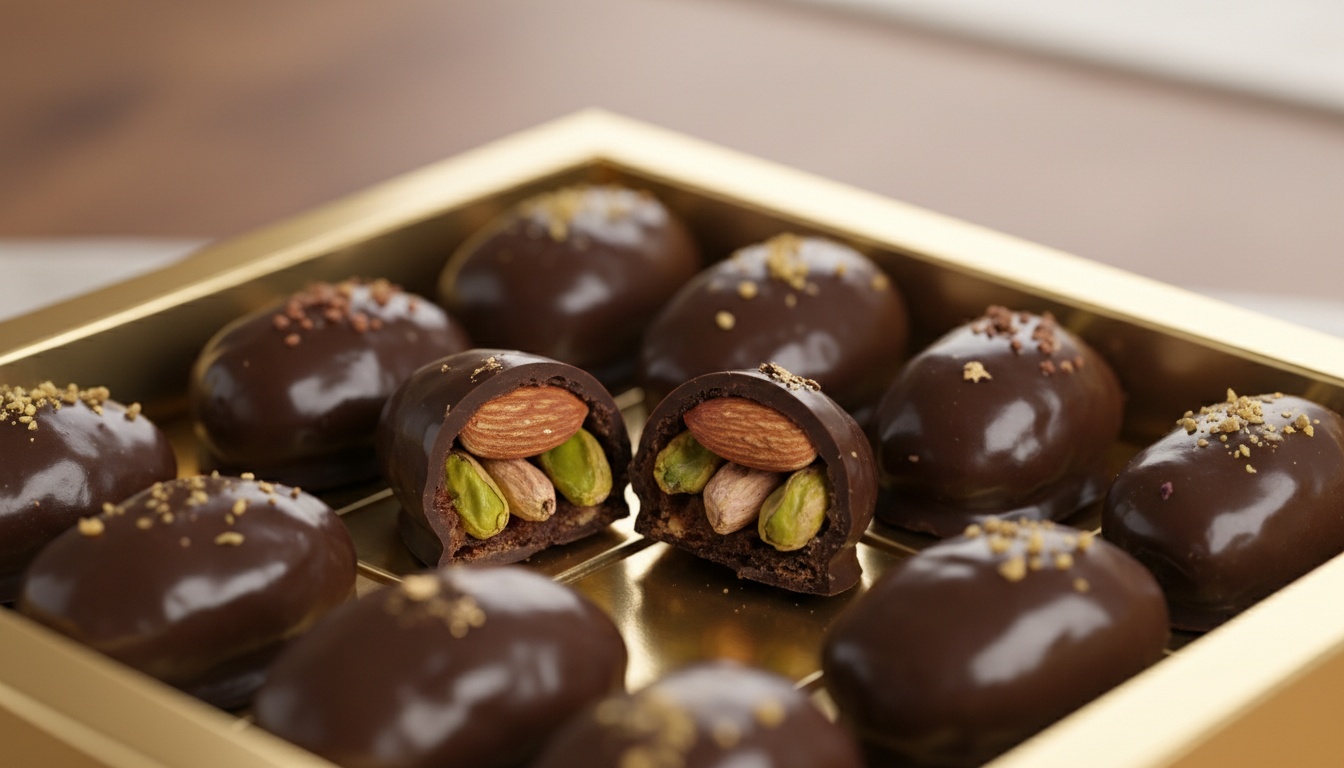
Stuffed and chocolate-enrobed dates are not a farm-gate commodity — they are a manufactured confectionery line, and the contract sits with a processing plant, not a grower. The base fruit is usually Khudri or Sukkari: both pit cleanly, hold their shape under a filling, and cost a fraction of the names printed on the gift box. Medjool appears only at the top of the range, where the variety itself is the selling point. Fillings run from whole roasted almonds, pistachios, walnuts and cashews to candied orange peel; enrobed lines use milk, dark or white Belgian-style couverture at roughly 30–40 per cent of finished weight. Grading works differently from plain dates: you specify piece count per kilogram, fill weight, coating percentage and pack format rather than a size class, and the plant's audit file matters more than the orchard. Buy only from ISO 22000 or HACCP-certified, Halal-registered factories — the serious Saudi processors cluster around Al-Kharj, Buraydah in Qassim and Madinah, and the better ones carry BRCGS as well. Certification is not a formality in this segment: nut fillings introduce allergen-control requirements the plain-date trade never deals with, and chocolate work demands tempering rooms and climate-controlled packing halls that a conventional date packhouse simply does not have.
This is the fastest-growing export category out of Saudi date processing, and the buyers are specific: Ramadan and Eid corporate-gifting programmes, airline and hotel amenity contracts, duty-free retail, and supermarket private label across the Gulf, Europe and North America. Price is quoted per finished kilogram and the date is the cheapest ingredient in it — nuts, couverture, hand-stuffing labour and packaging drive the number, which is why the band runs several times the plain-fruit price and why negotiating hard on the fruit spec saves you almost nothing. What the chocolate adds, beyond margin, is a cool chain: enrobed lines must ship at 18–20°C and never below about 13°C — a reefer set too cold causes condensation and sugar bloom on arrival, and daily temperature swings above 3°C are the usual culprit when a shipment lands grey. Nut-stuffed, uncoated lines are more forgiving and can move at ambient in the cooler months. For private label, plan around plant minimums of roughly 500–1,000 boxes per printed SKU and four to eight weeks of lead time; Ramadan programmes should be confirmed by December at the latest. Note also that the HS code changes with the coating — stuffed dates enter as prepared fruit, chocolate-enrobed as confectionery — with real duty consequences in some markets.
Excluded origins are not offered, including product re-exported, blended or re-processed through a third country. Every lot moves with a certificate of origin naming the producing plant, mine or grower country, and nothing is quoted before the seller and loading point are known.
Indicative reference
$6,500–18,000 USD / MT
as at September 2026
Reference level only — not an offer, and reviewed quarterly. Levels shown are as at September 2026. Firm pricing is quoted per RFQ, subject to volume, terms and inspection.
Typical Specification
Specifications are indicative and adjusted to the agreed contract and destination requirements. Final spec confirmed on COA / SGS.
Available Grades
Applications
- Ramadan & Eid corporate gifting
- Airline & hotel amenity programmes
- Premium retail & supermarket private label
- Duty-free & travel retail confectionery
- Wedding & event favours
Category
Agri-Foods, Spices & Nuts
Incoterms
FOB · CFR · CIF
Pricing basis
USD / MT
Inspection
SGS / Intertek at load port
Stuffed & Chocolate Dates — buyer questions
What is the realistic MOQ for a private-label gift-box programme?
For stock packaging with your sleeve or sticker, most plants will run from around 100–300 boxes. Fully custom printed rigid boxes are a different order: carton printers impose their own minimums, so expect 500–1,000 boxes per SKU as the practical floor, or roughly 500 kg to one tonne of finished product. Lead time is four to eight weeks including packaging origination — longer before Ramadan, when every plant is at capacity. If your programme is seasonal, confirm designs and quantities by December; a January order for a March Ramadan delivery is routinely refused or surcharged.
How do chocolate-enrobed dates survive a sea shipment to Europe or Asia?
In a reefer set at 18–20°C with humidity below 65 per cent — and the set point matters as much as the range. Below about 13°C the product picks up condensation as it warms on discharge, and that moisture triggers sugar bloom: the chocolate arrives grey and dull, cosmetically ruined though perfectly safe. Daily swings of more than about 3°C cause most claims, not the average temperature. For LCL quantities, insulated liners and gel packs work on shorter routes in cooler months. Dark chocolate is the most forgiving coating, white the least; nut-stuffed uncoated lines can ship ambient outside summer.
Which base date should I specify — and is Medjool worth the premium?
Specify Khudri or Sukkari unless the variety name is printed on the box. Both pit cleanly, hold their shape under a whole almond, and carry chocolate well; once a date is stuffed, enrobed and boxed, almost nobody can identify the fruit inside, so paying Medjool money for an anonymous centre is wasted spec. Medjool earns its premium only in named, uncoated stuffed lines where its size and moist texture are visible selling points — top-end gift trays, not enrobed assortments. If a supplier quotes suspiciously cheap Medjool enrobed dates, assume the centre is something else.
Why does the HS code change, and what does it cost me?
Plain dates enter under 0804.10. Stuff them with a nut and most customs authorities treat them as prepared fruit under 2008.99; coat them in chocolate and they generally become chocolate confectionery under 1806.90. That shift is not academic: Chapter 18 lines often carry higher duty than fruit lines, and in some markets sugar or dairy content triggers additional charges. Mixed gift boxes containing both types may be classified on the predominant product or split by line. Obtain a binding tariff ruling in your import market before committing to a container — reclassification at the border erases a thin gifting margin quickly.
Ready to source Stuffed Dates?
Send your quantity, specification, preferred Incoterms and destination port. Qualified requirements receive a workable offer against verified supply.
Have Stuffed Dates to sell? Submit an offer — we'll match it against live buyer demand.
More in Saudi Dates
Ajwa Dates
Madinah-only origin — graded by count, skin & provenance
Ajwa Al Aaliya Dates
Named-farm Ajwa from Madinah's Al-Aaliya basalt belt
Anbara (Amber) Dates
Madinah's largest date — graded on count, priced on size
Safawi Dates
Madinah semi-dry, near-black, ambient-stable · FOB Jeddah
Mabroom Dates
Madinah's long date — graded on length, sold on looks
Sagai Dates
Two-tone Najd semi-dry — graded by piece weight & count
Sukkari Dates
Qassim golden Sukkari — soft (rutab) & mufattal, by count
Khalas Dates
Al-Ahsa amber semi-dry, 60–90 count, ambient-stable
Khudri Dates
Semi-dry Saudi volume date — size-graded, year-round FCL
Saudi Medjool Dates
AlUla & Al-Jouf Medjool by calibre and skin grade
Barni Dates
Semi-dry Madinah date — Grade 1/2, Al-Ais provenance
Shalabi Dates
Scarce Madinah variety — lot-certified, part-load supply
Rabia Dates
Madinah value date graded on count, moisture and defects
Mashrooq Dates
Mid-tier Madinah date — caramel-sweet, sold by count band