
Caustic Soda (Sodium Hydroxide)
Flakes, pearls and 50% lye by NaOH, chloride and iron
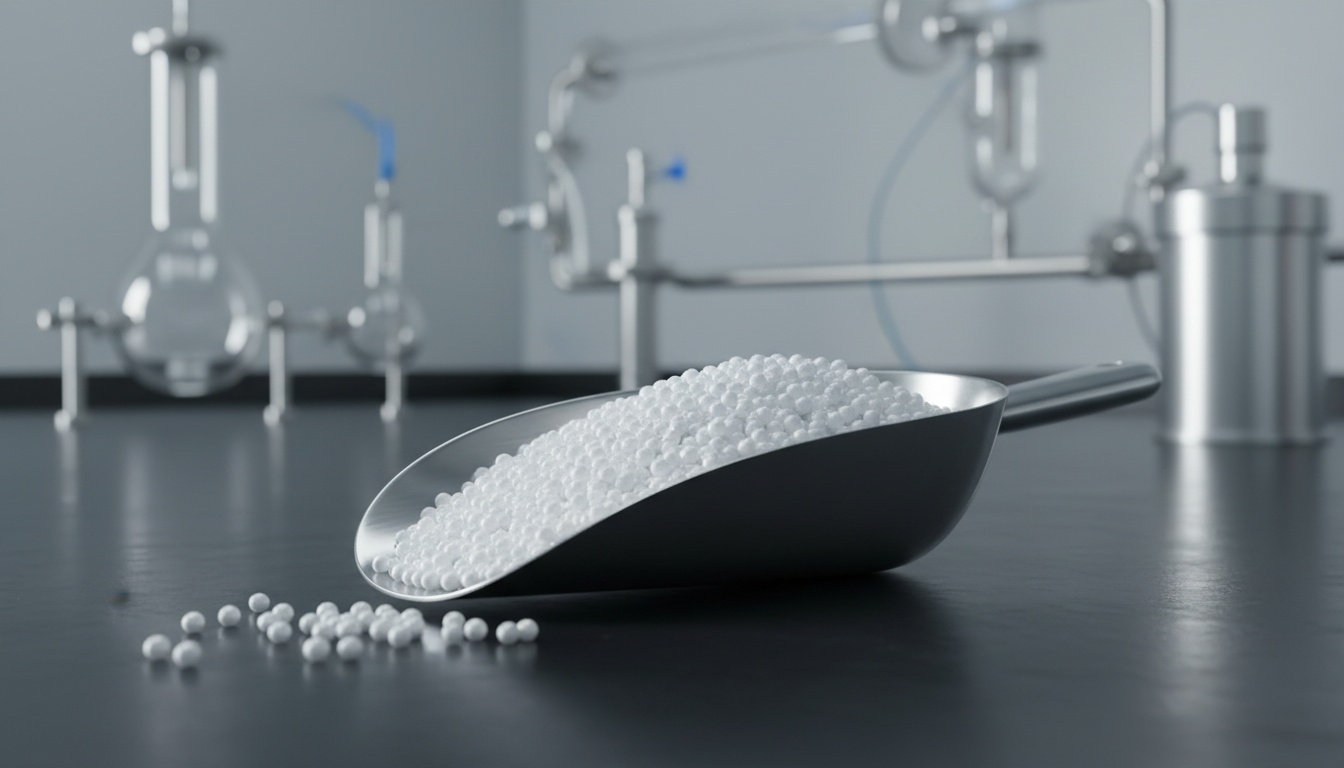
Caustic soda is one product sold in two physical forms, and the form decides the whole logistics chain before the chemistry is discussed. Caustic soda lye (HS 2815.12) is the 48–50% NaOH solution that leaves the chlor-alkali cell, and it moves in stainless or coated chemical-tanker parcels of 3,000–20,000 MT and in 20–24 MT ISO tanks into a buyer with a storage tank. Caustic soda flakes and pearls (HS 2815.11) are the same liquor evaporated to 98–99% NaOH and sold in 25 kg bags, for buyers who have no tank, who are far inland, or who want to pay freight on 100% caustic instead of 50% water. On the sheet the numbers are NaOH content, sodium carbonate (≤ 0.5–1.0%, the sign of carbon-dioxide pick-up), chloride (≤ 0.01% for membrane grade against up to 1% for diaphragm grade, which is what separates the two processes commercially), iron (≤ 10–20 ppm) and, for lye, specific gravity at 20 °C. Membrane grade is the default in alumina, viscose, food and pharmaceutical use; diaphragm grade is acceptable in pulp, soap and most water treatment and prices lower. UN Comtrade 2025 export declarations under HS 2815 show the Asian and Gulf supply that serves the Indian Ocean and Africa: India 0.69 million MT at an average USD 492/MT, Saudi Arabia 0.27 million MT at USD 412/MT, Egypt 0.18 million MT at USD 351/MT, Thailand 0.16 million MT at USD 361/MT, Canada 59,000 MT at USD 706/MT and Malaysia 57,000 MT at USD 441/MT, across 19 reporting origins. The averages blend lye and solid caustic, which is why the same reporter can show USD 350 one year and USD 500 the next as the mix shifts.
The buyer is an alumina refinery running the Bayer process (the largest single use), a kraft pulp mill, a viscose or textile mercerising plant, a soap and detergent maker, a water utility neutralising acid streams, a food processor or an oil refinery. Alumina, pulp and refineries buy lye by the tanker parcel or the ISO tank; soap makers, textile dyehouses and the distribution trade buy flakes and pearls in bags. CBIL is a commodity brokerage company and brokers caustic soda lye, flakes and pearls from Indian, Saudi, Egyptian, Thai and Malaysian chlor-alkali producers and trader allocations against SGS or Intertek certification of NaOH, sodium carbonate, chloride, iron and specific gravity at load, on FOB, CFR and CIF terms. Lye parcels are structured in chemical-tanker lots and ISO tanks, and because CBIL also runs a chartering desk (LaycanDesk) that works chemical tankers, freight can be quoted alongside the cargo so a CFR number and an FOB-plus-fixture number are comparable on the same day. Flakes and pearls go in 25 kg bags palletised in containers. Send your grade (membrane or diaphragm), form, monthly offtake and whether you have tank storage, and we will work the origin to it.
Need the ship as well? Our chartering desk prices chemical parcel tanker chartering on LaycanDesk.
Indicative reference
$340–520 USD / MT
as at September 2026
Reference level only — not an offer, and reviewed quarterly. Levels shown are as at September 2026. Firm pricing is quoted per RFQ, subject to volume, terms and inspection.
Typical Specification
Specifications are indicative and adjusted to the agreed contract and destination requirements. Final spec confirmed on COA / SGS.
Available Grades
Applications
- Alumina refining (Bayer process)
- Pulp & paper (kraft pulping, bleaching)
- Textiles & viscose (mercerising, rayon)
- Soap & detergent manufacture
- Water & effluent treatment
- Petroleum refining & petrochemicals
Category
Petroleum & Energy
Incoterms
FOB · CFR · CIF
Pricing basis
USD / MT
Inspection
SGS / Intertek at load port
Caustic Soda (Sodium Hydroxide) — buyer questions
Should I buy lye or flakes?
Lye if you have a tank and a berth or a road-tanker route to it, because it is cheaper per tonne of NaOH once the evaporation step is removed, and it pumps straight into the process. Flakes or pearls if you have no storage, if you are inland with a long truck leg (you pay freight on 100% NaOH, not on 50% water) or if your consumption is a few tonnes a month. A 20 MT ISO tank of 50% lye carries 10 MT of NaOH; a 20 MT container of flakes carries about 19.7 MT. Work the delivered cost per tonne of contained NaOH, not per tonne of product.
What is the difference between membrane and diaphragm grade?
The cell technology that made it, and the chloride that came with it. Membrane cells give a 32% liquor evaporated to 50% with chloride below 0.01%; diaphragm cells give a liquor that still holds up to 1% sodium chloride and some sodium chlorate after evaporation. Alumina refineries, viscose plants and food and pharmaceutical users specify membrane grade; kraft pulp, soap and general water treatment usually accept diaphragm grade, which prices lower. Ask for the chloride figure on the certificate rather than the word.
How is a caustic lye parcel shipped and what does the buyer need at the discharge end?
In stainless-steel or suitably coated chemical-tanker tanks, typically 3,000–20,000 MT, with the load-port surveyor certifying NaOH, carbonate, chloride, iron and specific gravity, and a discharge-port survey if the contract calls for it. The buyer needs a shore tank rated for 50% caustic (carbon steel is normal below about 50 °C), heated lines in cold climates because 50% lye starts to crystallise around 12 °C, and a pump and hose connection at the berth. Because CBIL also runs a chartering desk that works chemical tankers, the freight leg can be quoted alongside the cargo.
Which origins serve the Indian Ocean and Africa?
UN Comtrade 2025 export declarations under HS 2815 show India at 0.69 million MT and an average USD 492/MT, Saudi Arabia at 0.27 million MT and USD 412, Egypt at 0.18 million MT and USD 351 and Thailand at 0.16 million MT and USD 361. Indian and Gulf lye serves East Africa, South Asia and the Middle East by tanker and ISO tank; Egyptian caustic serves the Mediterranean and East Africa; Thai and Malaysian flakes serve Southeast Asia and the Indian Ocean in containers. The averages mix lye and solid caustic, so compare offers on the same form.
Ready to source Caustic Soda?
Send your quantity, specification, preferred Incoterms and destination port. We'll verify supply and respond with a workable offer — usually within one business day.
Have Caustic Soda to sell? Submit an offer — we'll match it against live buyer demand.
More in Caustic Soda, Soda Ash & Calcium Carbonate