
Industrial & De-icing Rock Salt
Bulk solar and rock salt for de-icing and chlor-alkali
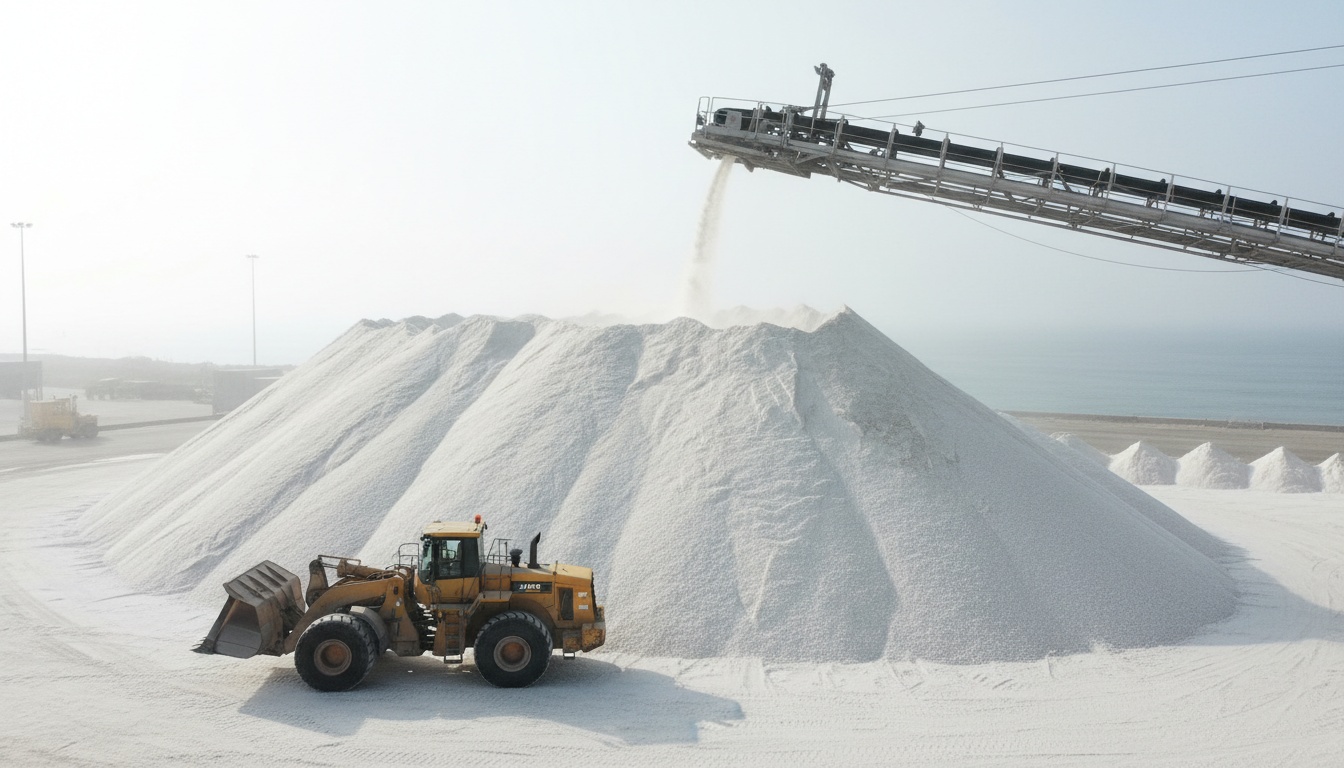
Industrial salt is the largest-volume commodity nobody prices carefully, because the cargo is worth less than the ship that carries it. Solar salt harvested from evaporation pans and rock salt mined from halite beds both trade on the same short sheet: sodium chloride 96–99.5% on a dry basis, moisture (2–5% for solar, under 1% for rock), insolubles, calcium and magnesium (which matter for chlor-alkali brine purity and set the membrane-cell grade apart from de-icing grade), sulphate, and a size distribution that decides whether it spreads from a gritter or dissolves in a saturator at rate. De-icing buyers, the municipalities and highway authorities of Canada, the northern United States and northern Europe, want a coarse 2–10 mm product with an anti-caking additive and accept lower purity; chlor-alkali plants want 99% plus with calcium and magnesium under a few hundred ppm, and pay for it. UN Comtrade 2025 declarations show the scale: India exported 19.5 million MT under HS 2501, half of it to China and a fifth to Korea, at an average USD 17–20 per MT FOB; Morocco exported 494,000 MT, 44% to the USA and 39% to Canada at USD 19–38; and Canada imported 1.31 million MT, from Mexico 470,000 MT, Brazil 310,000 MT, Chile 305,000 MT and Morocco 192,000 MT. Egypt reports its salt exports by value only, with the USA among its partners.
At USD 15–40 per MT FOB the freight is one to two times the cargo, so an industrial salt enquiry is a freight enquiry wearing a cargo's clothes, and the winner is whoever fixes the ship best: a Supramax or Panamax on a contract of affreightment for the de-icing season, loading at 8,000–15,000 MT a day from a stockpile with a conveyor or grab, discharging into a port stockpile before the first frost. CBIL is a commodity brokerage company and brokers industrial salt from Indian, Mexican, Chilean, Moroccan, Egyptian and Australian producers and trader positions against SGS or Intertek certification of NaCl, moisture, insolubles, calcium, magnesium, sulphate and sizing, on FOB, CFR and CIF terms; because CBIL also runs a chartering desk (LaycanDesk), the annual freight contract is priced with the cargo rather than left to the buyer, which for this commodity is most of the delivered price. Send the grade (de-icing or chemical), the monthly tonnage and window, the discharge port and its stockpile arrangement, and we will work the producer and the tonnage together.
Need the ship as well? Our chartering desk prices chemical parcel tanker chartering on LaycanDesk.
Indicative reference
$15–45 USD / MT
as at September 2026
Reference level only — not an offer, and reviewed quarterly. Levels shown are as at September 2026. Firm pricing is quoted per RFQ, subject to volume, terms and inspection.
Typical Specification
Specifications are indicative and adjusted to the agreed contract and destination requirements. Final spec confirmed on COA / SGS.
Available Grades
Applications
- Road de-icing & winter maintenance
- Chlor-alkali (caustic soda & chlorine)
- Water softening & treatment
- Oil & gas drilling brines
- Textile, dye & tannery processing
Category
Petroleum & Energy
Incoterms
FOB · CFR · CIF
Pricing basis
USD / MT
Inspection
SGS / Intertek at load port
Industrial & De-icing Rock Salt — buyer questions
Why is the freight quote more important than the FOB price?
Because at USD 15–40 per MT FOB the cargo is worth less than the voyage. A Supramax from the Mediterranean or Mexico to the St Lawrence costs more per tonne than the salt in it, so the delivered price is decided on the chartering desk, not the salt pan. We price the contract of affreightment with the cargo so you see one delivered number.
What is the difference between de-icing and chemical grade?
De-icing salt is coarse, 2–10 mm, treated with an anti-caking agent and accepted at 96–98% NaCl; it is bought on price and spreadability. Chemical grade for chlor-alkali is 99.5% plus with calcium, magnesium and sulphate held low, because those ions foul membrane cells. Specifying chemical grade for road use pays for purity the gritter cannot use.
What loading rates and parcel sizes are normal?
25,000–35,000 MT Handysize and 50,000–60,000 MT Supramax and Panamax lots. Solar salt loads from stockpiles by conveyor at 10,000–20,000 MT a day; rock salt from mine stockpiles by grab or loader at 5,000–10,000 MT a day. A de-icing programme is usually contracted as monthly liftings for the season rather than spot voyages.
Can you supply Canada and the northern USA?
Yes, and the reference lane is Morocco and Mexico into Montreal and the US East Coast, alongside Chile and Brazil. Canada imported 1.31 million MT in 2025 by its own customs data. We work a new origin against that benchmark and against the receiver's stockpile and berth, and price the season's freight with it.
Ready to source Industrial Salt?
Send your quantity, specification, preferred Incoterms and destination port. We'll verify supply and respond with a workable offer — usually within one business day.
Have Industrial Salt to sell? Submit an offer — we'll match it against live buyer demand.
More in Caustic Soda, Soda Ash & Calcium Carbonate